
Not all jackets are equal, and not all jacket decisions are the same. The jacket you reach for on a Monday morning in a client-facing role is doing a different job than the one you pull on for a weekend lunch. Understanding the distinct types of jackets available to women, and what each one actually does, makes every outfit decision faster, more confident, and more consistent.
This guide covers the jacket types that matter for a considered woman’s wardrobe: what they are, how they function, when they belong, and what to look for in each one. The focus is on structured tailoring, because that is the territory where the investment pays off most clearly. Explore the full range of blazers for women and military blazers at The Extreme Collection USA.
The Blazer
The blazer is the most versatile structured jacket in a woman’s wardrobe. It is not part of a suit. It requires no matching bottom. Its purpose is to function independently as the piece that defines and elevates whatever surrounds it. A well-chosen blazer covers more ground than any other single jacket type: professional dressing, smart casual occasions, evening events, and relaxed weekend contexts, all without requiring a change of garment.
What makes a blazer a blazer is its construction. A defined lapel, a structured shoulder that sits at the natural shoulder seam, a front that closes or opens with equal effect, and a canvas interlining that gives the garment its shape. These elements work together to produce the visual impression of intention: when a woman walks into a room wearing a well-made blazer, the immediate read is that she dressed deliberately.
The blazer category is wide. It encompasses single-breasted and double-breasted silhouettes, cropped and longline cuts, neutral solids and expressive prints, structured crepes and relaxed linens. The common thread is the construction standard: a blazer that cannot hold its shoulder through a full day of wear, that loses its shape in the afternoon, or that reads differently at five o’clock than it did at nine, is not performing its function.
For a detailed guide to how different blazer silhouettes interact with body type and occasion, our post on choosing the perfect blazer for your body type and occasion covers the decisions in full.
The blazer below is a strong expression of the category in print. An organic blue pattern against a light ground, handcrafted tailoring, an asymmetric hem, and a coral-toned lining. The kind of piece that reads as considered in any register.
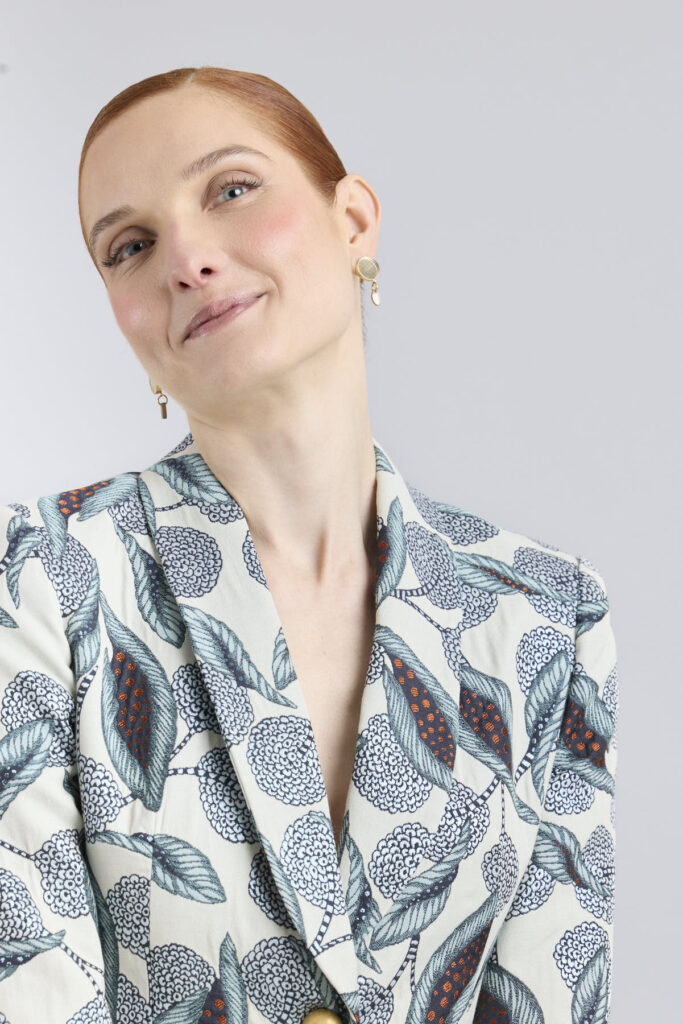
The blazer below takes the single-breasted silhouette in a different direction: a clean linen construction in a sandy beige that moves with ease while holding its shape. The linen blazer is the right answer for warm months and relaxed professional contexts where heavier fabric would feel out of register.

A blazer is a specific type of structured jacket designed to be worn independently of a matching bottom. All blazers are jackets, but not all jackets are blazers. What defines a blazer is its construction: a defined lapel, a structured shoulder, and a canvas interlining that gives the garment its shape and allows it to perform across a wide range of occasions without requiring a matching bottom or specific context.
The Military Blazer
The military blazer is the most architecturally precise expression of structured tailoring for women. Where a standard blazer communicates professionalism and polish, a military blazer communicates command. The defined shoulder, the symmetrical front closure, the precision button placement, and the mandarin or stand collar: these elements derive from garments designed to signal rank and discipline. They continue to carry that weight in contemporary tailoring.
What separates the military blazer from other jacket types is not decoration but structure. The military silhouette holds its line more firmly than a standard blazer. The shoulder is more defined. The front closure is more symmetrical. The overall effect is a garment that communicates authority before the wearer has moved or spoken. For professional occasions, high-stakes contexts, and any room where presence matters, the military blazer is the most direct answer in the jacket category.
The military blazer also travels further across registers than most jacket types. The same piece that reads as authoritative in a morning meeting reads as considered and distinctive at a weekend event. The structure that communicates authority in a professional context reads as personality in a casual one. Very few jacket types achieve this range.
The jacket below is the white military silhouette at its most architectural: ivory construction with black mandarin collar and contrast detailing that reads with immediate clarity in any context.
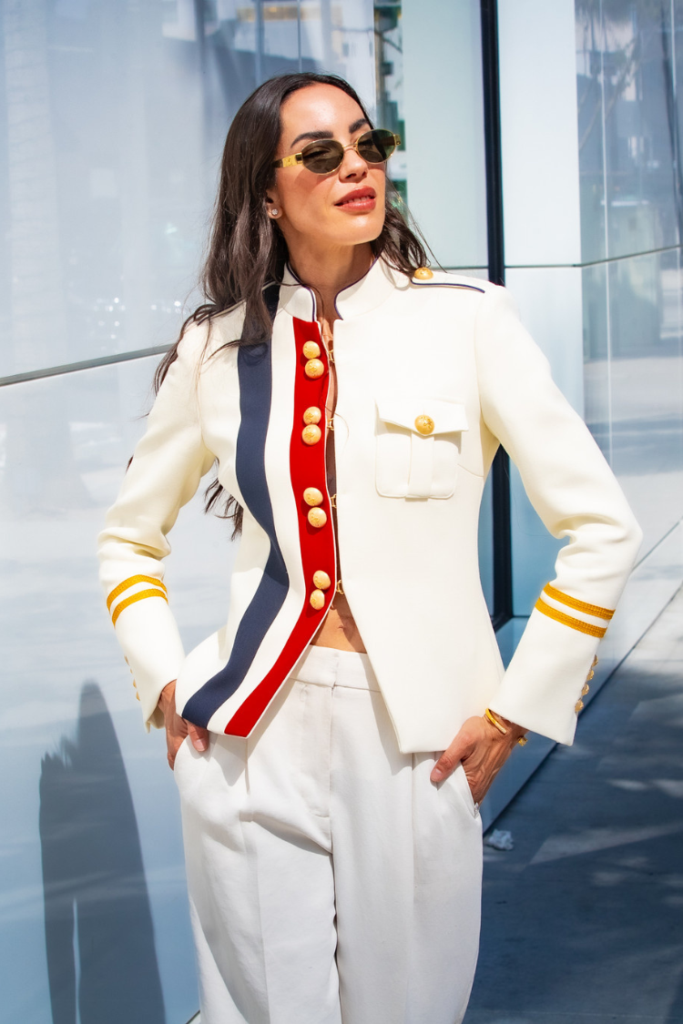
The jacket below offers the military silhouette in ivory tones with spectacular fish-motif embroidery in antique gold thread. A piece that moves from professional to evening to special occasions without requiring explanation.
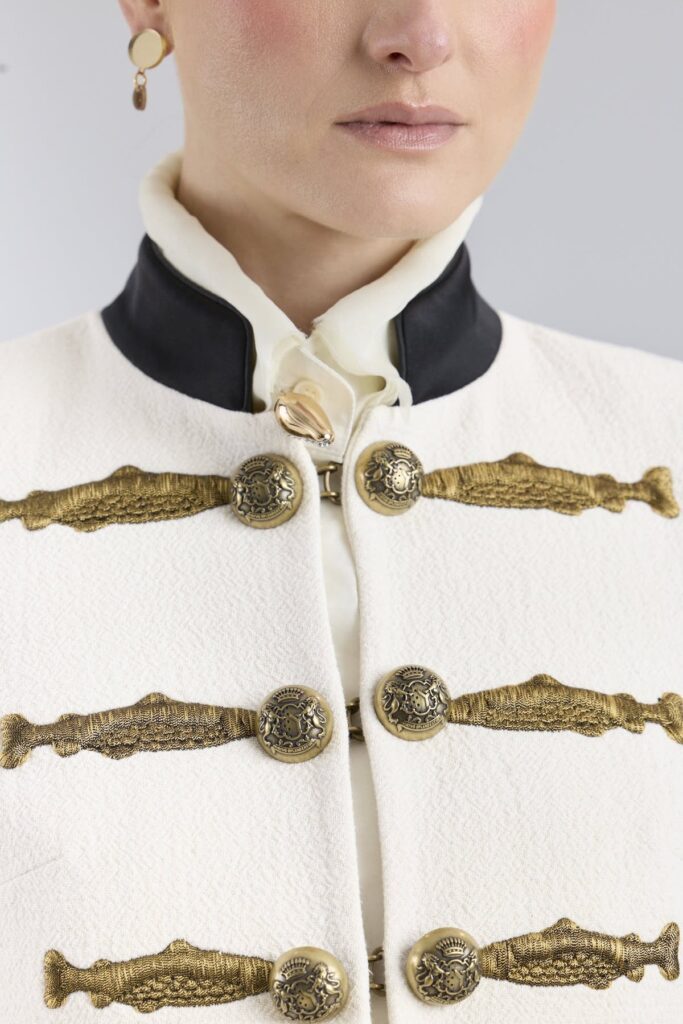
The full cultural and construction analysis of the military blazer is in our editorial on military blazers for women: structure, purpose and modern refinement, and in our post on why the military jacket never goes out of style.
A military blazer is defined by structural elements derived from military dress: a defined and precise shoulder, a symmetrical front closure with ornamental or heritage-inspired buttons, a high or mandarin collar, and a sculpted waistline that sharpens the vertical proportion. These elements communicate authority through architecture rather than decoration, which is why the military blazer performs across a wider range of occasions than most other jacket types.
The Suit Jacket
The suit jacket is the upper half of a matched suit. Its defining characteristic is that it is constructed to pair with a specific bottom made from the same fabric, cut, and color. Unlike a blazer, a suit jacket is not designed to operate independently. Worn without its matching bottom it reads as incomplete. Worn as a complete suit it is the clearest available signal of formal professional authority.
The suit jacket belongs at the formal end of the professional dressing spectrum: court appearances, executive presentations, formal interviews, and any context where business professional rather than business casual is the operative standard. Its precision is its strength in those contexts and its limitation outside them. A suit jacket cannot move between registers the way a blazer can.
For most women’s wardrobes, a well-chosen blazer covers the territory a suit jacket occupies while also covering significant additional ground. The suit jacket earns its place in wardrobes where the formal end of the professional spectrum is a regular requirement. For occasional formal needs, a structured blazer in a neutral tone often performs adequately without the constraint of the matched bottom.
The Double-Breasted Jacket
The double-breasted jacket is defined by its two parallel rows of buttons and overlapping front panels. It can appear as a blazer, a suit jacket, or a military blazer. The silhouette creates a strong vertical line and a more formal visual weight than a single-breasted equivalent. Double-breasted construction communicates formality and intention more loudly than single-breasted construction, which makes it particularly effective in contexts where the goal is to make a clear statement.
For women, the double-breasted blazer is one of the most effective choices for professional settings that require authority beyond the standard business casual register. It is also one of the strongest options for smart casual occasions where the relaxed context permits a more declarative jacket.
The jacket below is the double-breasted silhouette in pearl tones: a military construction with the luminous surface and structural authority that makes this format particularly effective for occasions where presence is the primary objective.
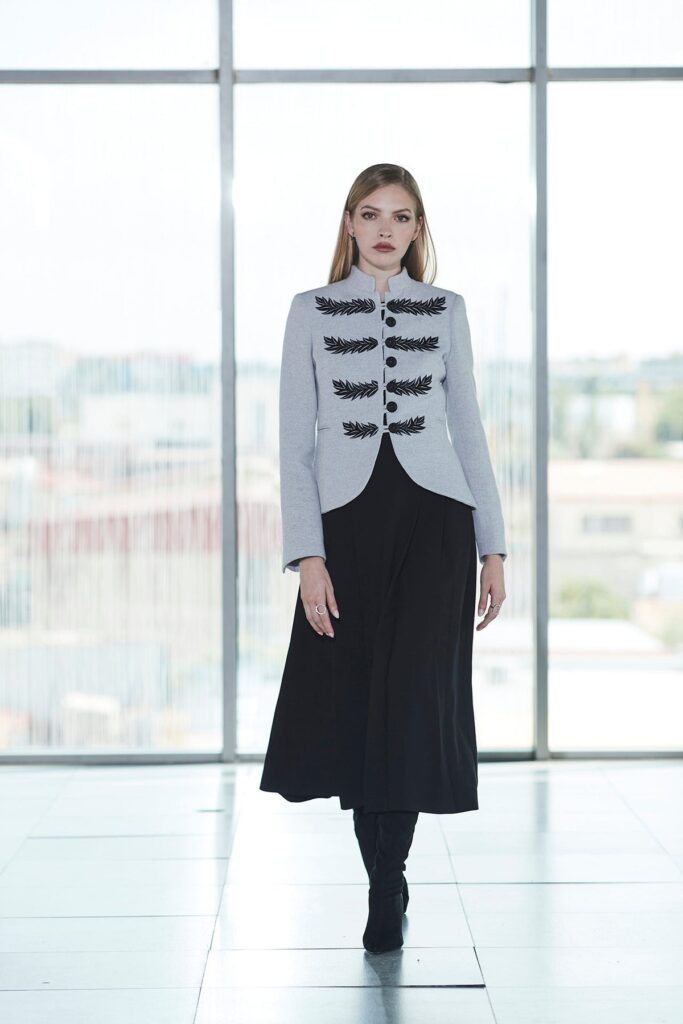
The Structured Knit Jacket
The structured knit jacket occupies the space between knitwear and tailoring. It applies the construction logic of a blazer to knit fabric: defined shoulders, a front closure, and an overall silhouette that reads as a jacket rather than as a cardigan or sweater. The result is a garment that combines the comfort and texture of knitwear with the visual authority of structured tailoring.
For women who want the consideration of a blazer with a softer hand feel and more relaxed weight, the structured knit jacket provides an effective alternative. It works in smart casual contexts, creative professional environments, and transitional season dressing where a heavier woven fabric feels excessive but a standard sweater feels insufficient.
The jacket below applies the vocabulary of luxury tailoring to a richly textured knit construction. Gold heraldic buttons, frayed edges, and a double-breasted silhouette that reads as a collector’s piece rather than a standard knitwear option.
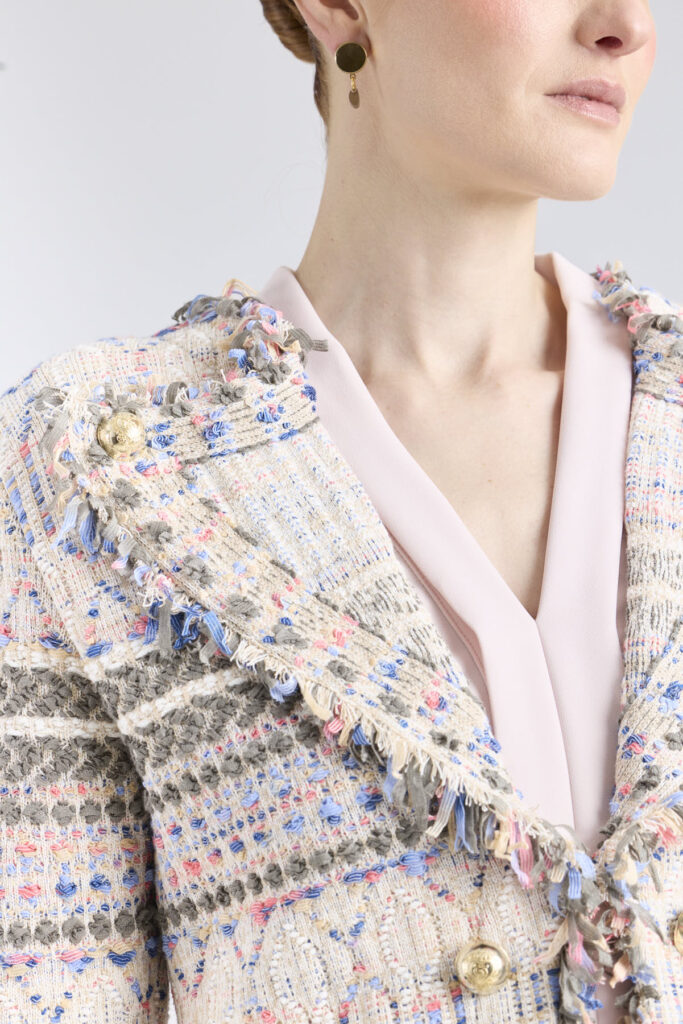
The jacket below takes the structured knit in a different direction: a tailored silhouette with a modern design and the kind of precise construction that allows it to travel from a creative office environment to a casual social occasion without adjustment.

Explore the full knitwear collection at The Extreme Collection USA for the complete range of structured knit pieces.
A structured knit jacket applies the construction principles of a blazer to knit fabric. It has a defined shoulder, a front closure, and a silhouette that reads as a jacket rather than a cardigan or sweater. The result combines the comfort of knitwear with the visual authority of structured tailoring, making it effective in smart casual and creative professional contexts where a heavier woven blazer would feel excessive.
The Linen Jacket
The linen jacket is not a jacket type separate from the blazer or suit jacket. It is a fabric category that applies across those silhouettes. What makes linen significant enough to address separately is how differently it behaves from heavier tailoring fabrics and what that difference produces in terms of wear.
Linen is lightweight, breathable, and naturally textured. In tailoring, it produces a jacket that reads as relaxed without losing its structure, which makes it the right choice for warm months, outdoor professional occasions, and environments where a heavier fabric would feel out of register. A linen blazer in a warm climate or a summer event performs the same function as a wool blazer in cooler conditions: it introduces structure and consideration without imposing weight.
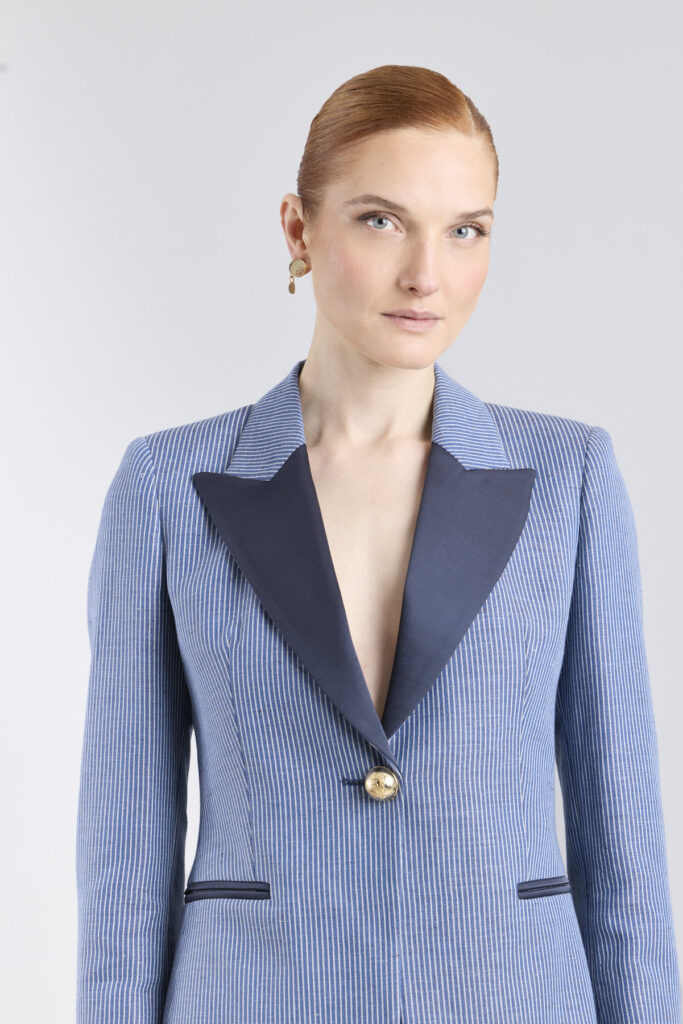
The linen jacket below takes a nautical stripe and elevates it through contrast navy peak lapels and the precision of handmade construction. A piece that reads as effortless while being entirely deliberate.
The Sport Coat
The sport coat is a casual jacket with origins in outdoor pursuits: shooting, riding, and country activities. Its construction prioritizes comfort and durability over precision tailoring. The shoulder sits softer than a blazer. The silhouette is more relaxed. The fabrics lean toward texture and weight: tweed, corduroy, heavy wool. It is built for resilience rather than refinement.
For women, the sport coat occupies a narrow register. It performs well in relaxed professional environments, creative industries, and casual social settings where intentional informality is the goal. It does not translate convincingly to formal professional contexts or client-facing situations where authority matters. The blazer covers everything the sport coat covers and significantly more, which is why the sport coat tends to be an addition to a well-stocked wardrobe rather than a foundation of one.
A full analysis of how the sport coat compares with the blazer and suit jacket for women is in our post on sport coat vs blazer: what every woman should know.
The blazer is the most versatile jacket type for women. It covers professional, smart casual, evening, and relaxed weekend contexts without requiring a matching bottom or specific occasion to justify it. A well-made blazer in a neutral tone handles the formal end of business casual and doubles as business professional when needed. A blazer in a distinctive color or fabric covers occasions where individual expression is appropriate. No other jacket type covers this range with equal reliability.
How to Choose the Right Jacket Type
The decision between jacket types is ultimately a question of what the occasion requires and what the garment needs to communicate. Different jacket types serve different functions, and understanding those functions makes the selection straightforward rather than uncertain.
For formal professional contexts, client-facing situations, and occasions where authority is the primary requirement, the military blazer or a well-structured blazer in a neutral tone is the right answer. Both communicate intention before the wearer speaks and hold their register across a full professional day.
For smart casual occasions, the blazer in a distinctive color, print, or fabric earns its place. It introduces the considered element smart casual requires while allowing enough personal expression to read as appropriate for the specific context. Our post on how a blazer solves the smart casual problem covers this territory in detail.
For business casual dressing, which remains the most common professional dress code, the blazer covers the full range from its most relaxed to its most polished expression. Our editorial on what business casual means for women applies this logic to the specific contexts most professional women navigate regularly.
For creative, casual, and relaxed occasions where intentional informality is appropriate, a structured knit jacket or a sport coat provides the right level of consideration without the formality that a blazer or military blazer would impose.
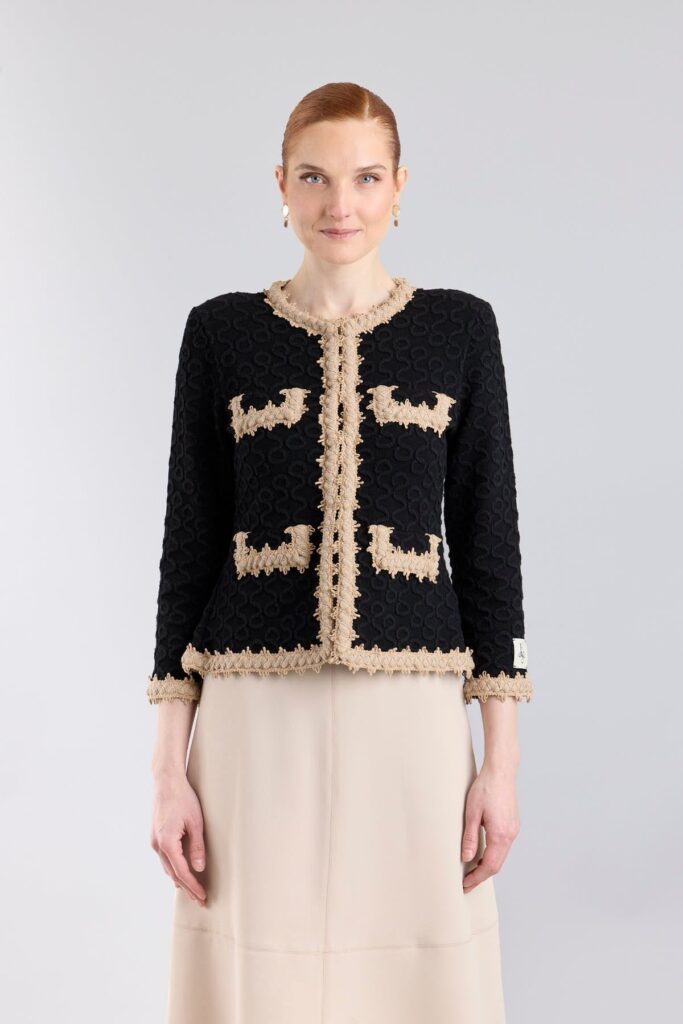
The jacket below is a strong example of a structured knit piece that bridges the casual and considered registers: an embossed texture and precise silhouette that reads as intentional without imposing the formality of a woven blazer.
Building a Jacket Wardrobe
A well-built jacket wardrobe does not require a large number of pieces. It requires the right pieces, chosen with enough intention that they cover the full range of professional and social contexts without overlap or redundancy.
The foundation is one or two blazers chosen for the professional contexts navigated most regularly: a structured piece in a neutral tone for formal and business casual occasions, and a second in a color or fabric with more personality for smart casual and social contexts. From that foundation, a military blazer adds the authority tier — the piece for high-stakes occasions, important meetings, and any room where presence needs to be established immediately.
A structured knit jacket or linen blazer fills the warmer-month and more relaxed context gaps that woven tailoring does not cover as naturally. The sport coat, if the wardrobe and lifestyle call for it, is an optional addition rather than a core element.
The quality of each piece matters more than the quantity of the collection. A canvas-interlined blazer that holds its shoulder through five years of regular wear performs better and costs less per use than three cheaper alternatives that require replacement. The investment logic applies across every jacket type: construction quality determines longevity, and longevity determines value.
Every piece in The Extreme Collection USA is made in Spain, finished by hand in limited quantities, and built to the standard that the garments described in this post demand. The full collection of blazers for women, military blazers, and knitwear is available at The Extreme Collection USA.