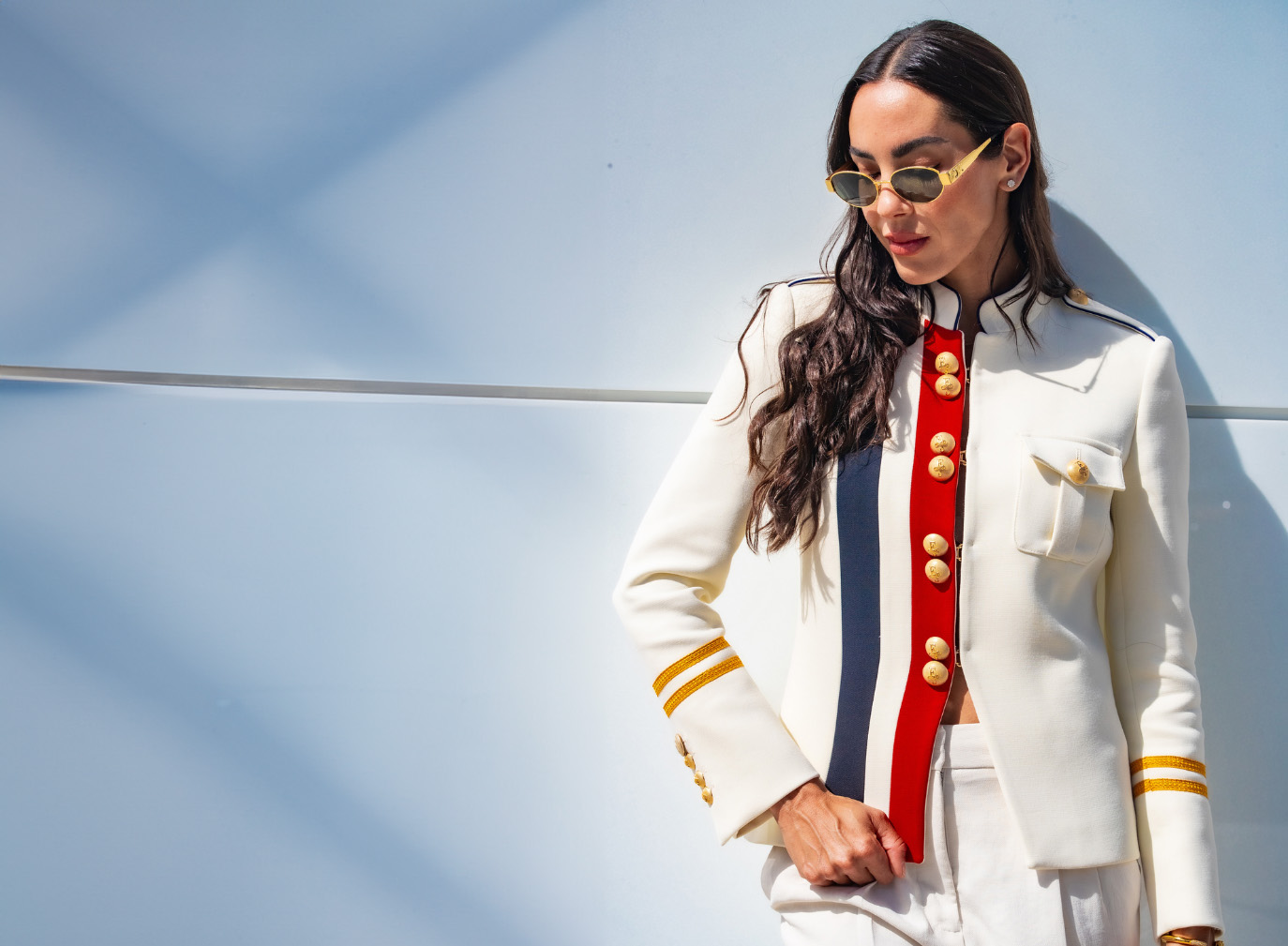
Fashion has borrowed from military dress for centuries. But borrowing is not the right word. What has happened is something more fundamental: the military jacket for women has been claimed, reinterpreted, and made entirely her own across successive generations, each finding in its structure a language that suited the moment.
The question worth asking is not whether the military jacket will return. It never left. The question is why this particular silhouette carries such persistent authority across cultures, decades, and contexts that have almost nothing else in common.
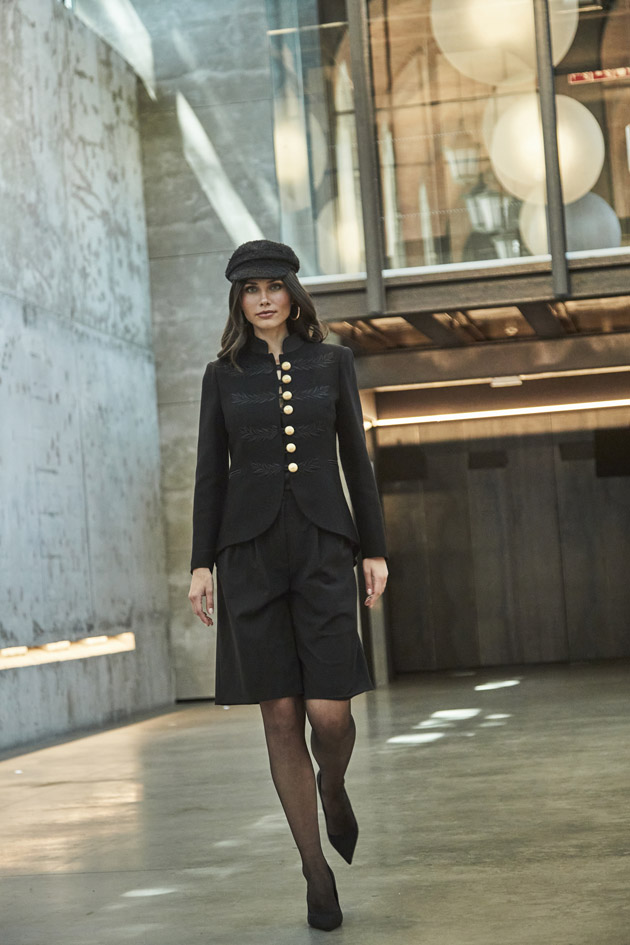
The 1960s: Subversion in Structured Form
The military jacket entered women’s fashion with clear intent during the 1960s. The decade was defined by a rejection of postwar constraint, and designers responded by pulling unexpected references into civilian dress. Military tailoring offered exactly the kind of structured provocation the era required: a silhouette with unambiguous associations, authority, discipline, hierarchy, worn deliberately by women who were in the process of challenging all three.
This was not costume. The Mod movement understood that appropriating the aesthetics of institutions was a form of critique. The braid, the button, the defined shoulder: worn on a woman in 1966, these elements communicated something that softer dressing could not. The garment became a vehicle for a position.
What is significant, looking back, is that the silhouette survived the decade it was politicized in. It did not expire with the movement that adopted it. That durability is telling. A garment that can carry a political argument without being reduced to it has something more than relevance. It has substance.
Punk and the Politics of the Shoulder
A decade later, punk arrived with a different relationship to military dress. Where the Mod appropriation was relatively clean, punk’s engagement was more aggressive and deliberately destabilizing. Military jackets appeared alongside safety pins, hand-painted slogans, and torn fabrics in combinations designed to generate maximum discomfort in the observer.
But here too, the military jacket women wore was doing specific work. Its structure, the defined line, the formal button placement, the precision of the collar, provided a framework against which everything else could rebel. Without the jacket’s underlying authority, the surrounding chaos would have read differently. The military silhouette gave punk its visual anchor.
This is a recurring pattern in the garment’s history: it provides the foundation from which departure becomes legible. You need the structure for the subversion to register. Strip away the jacket and the provocation loses its reference point.
The 1980s: Power Dressing and the Shoulder’s Ascent
The 1980s formalized what earlier decades had intuited. Power dressing as a cultural phenomenon placed the shoulder at the center of how professional women were expected to present themselves. The silhouette that resulted, wide at the shoulder, defined at the waist, unambiguous in its proportions, owed an explicit debt to military tailoring even when the garments involved were nominally civilian.
Designers including Giorgio Armani and Thierry Mugler built entire visual languages around this structural logic. The military jacket women had been wearing informally for two decades became the template for a new form of professional authority. The shoulder was no longer subversive. It was aspirational.
What the decade produced was a mainstreaming of military aesthetics that stripped some of their edge while dramatically expanding their reach. The defined shoulder moved from counterculture to boardroom. The silhouette proved adaptable enough to survive the transition without losing its essential character.
Why the Silhouette Endures
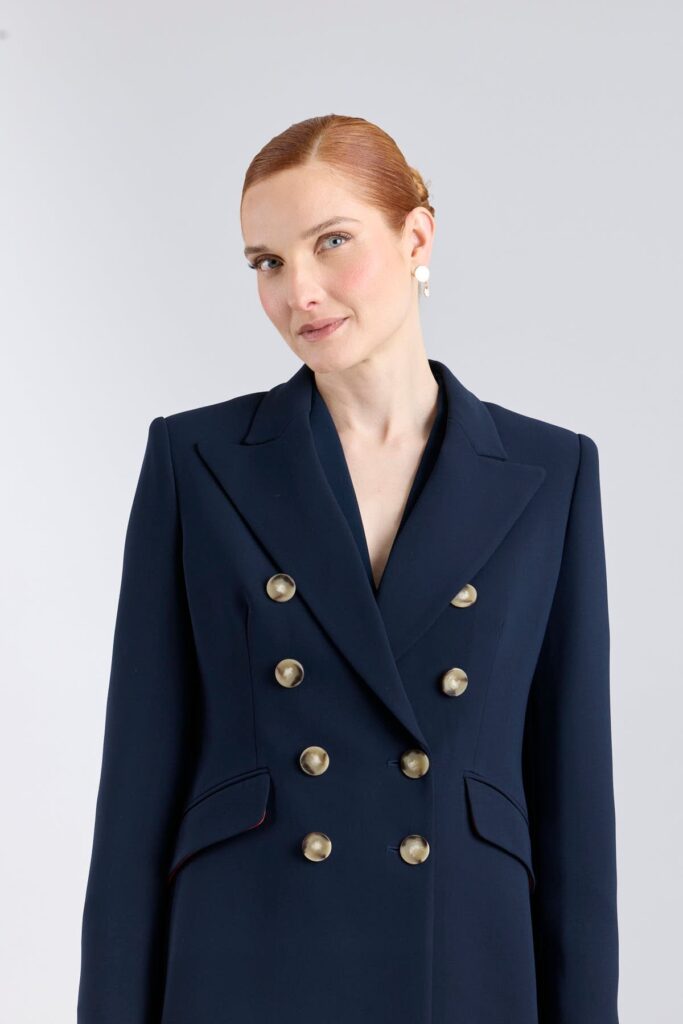
Each of these moments, separated by culture, intent, and aesthetic, shares a common logic. The military jacket for women endures because it does something no other garment achieves with the same consistency: it restructures the body’s relationship to space.
The defined shoulder expands presence. The structured front creates verticality. The precision of collar and closure directs attention. These are not decorative effects. They are architectural ones, and architecture, unlike decoration, does not date in the same way.
This is why the military blazer returns reliably to the runway. It is not nostalgia. Designers revisit military structure because it solves problems of presence and proportion that softer construction cannot address. The silhouette offers something genuinely useful to women who understand what clothing does beyond covering the body.
The deeper analysis of how this construction operates in contemporary luxury tailoring runs through our editorial on military blazers for women: structure, purpose, and modern refinement.
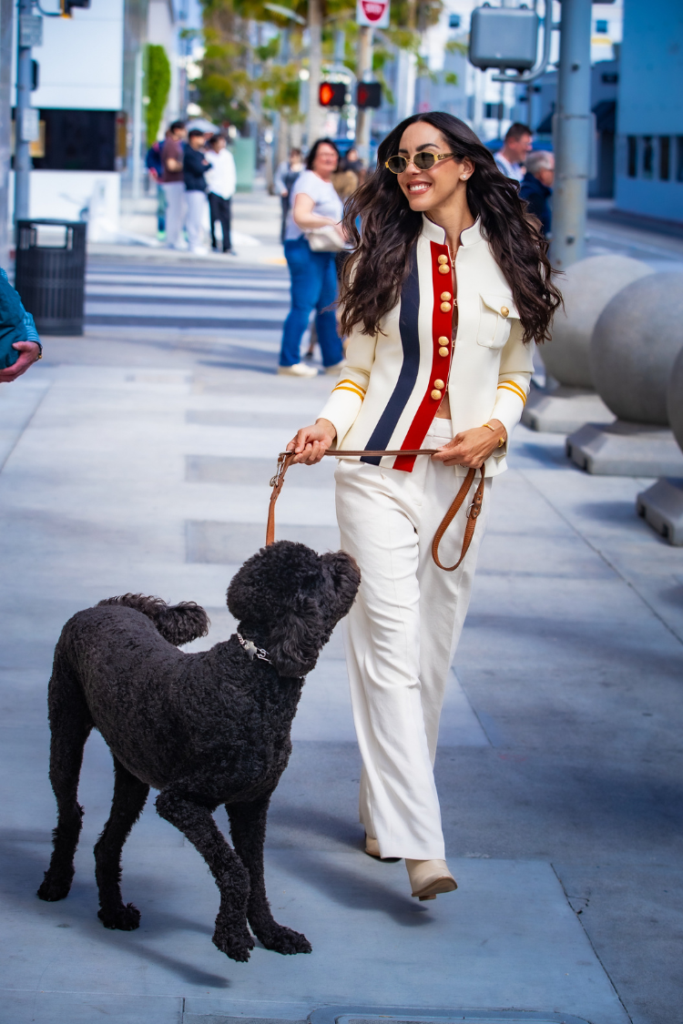
The military jacket offers structural properties that softer tailoring cannot replicate: a defined shoulder that expands presence, a structured front that creates verticality, and precision detailing that communicates authority. These are architectural effects rather than decorative ones, which means they remain relevant regardless of trend cycles. Each generation finds a different use for the silhouette without exhausting it.
The 1990s and 2000s: Quiet Authority
Following the theatrical maximalism of the 1980s, the military jacket entered a more restrained phase. The 1990s preference for minimalism did not eliminate the silhouette but refined it. Shoulders became less exaggerated. Cuts leaned cleaner. The military influence became more embedded in the architecture of a garment rather than announced through surface detail.
This phase is arguably the most interesting in the garment’s history precisely because it is the least visible. Military tailoring stopped announcing itself and started operating beneath the surface of mainstream professional dressing. Women wore structured jackets without identifying them as military. The influence had become so thoroughly absorbed that it no longer required a name.
Into the 2000s, the silhouette reasserted itself more explicitly through the work of designers like Balmain, whose sharp-shouldered, heavily embellished military jackets returned the garment to its most declarative register. The pendulum, as always, swung back. The restrained years had not diminished the silhouette. They had simply allowed it to consolidate.
Embellishment as Evolution
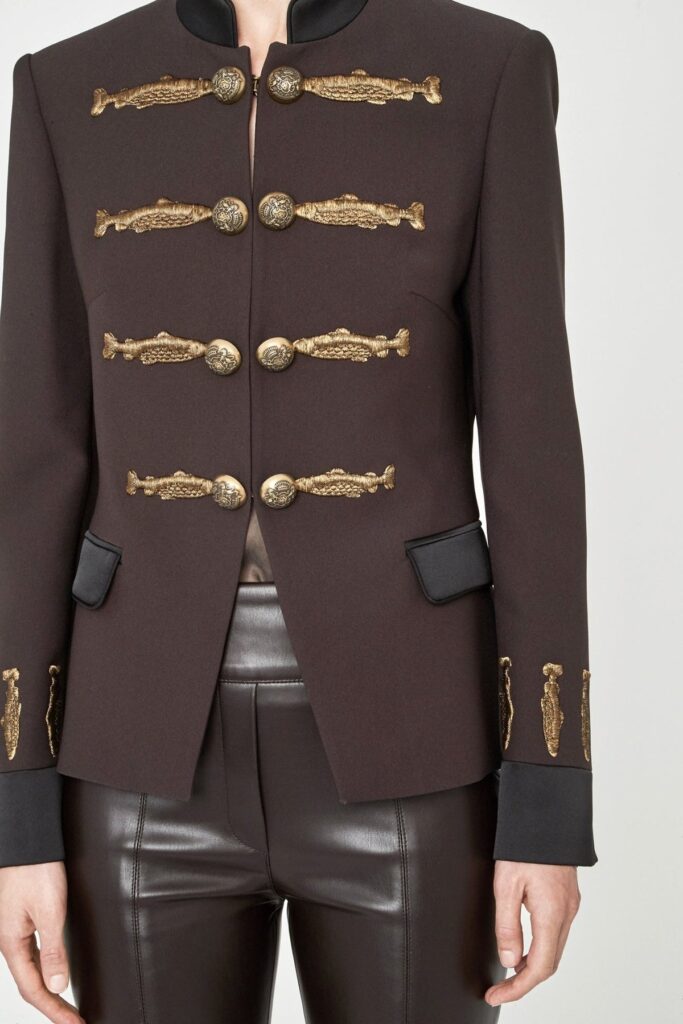
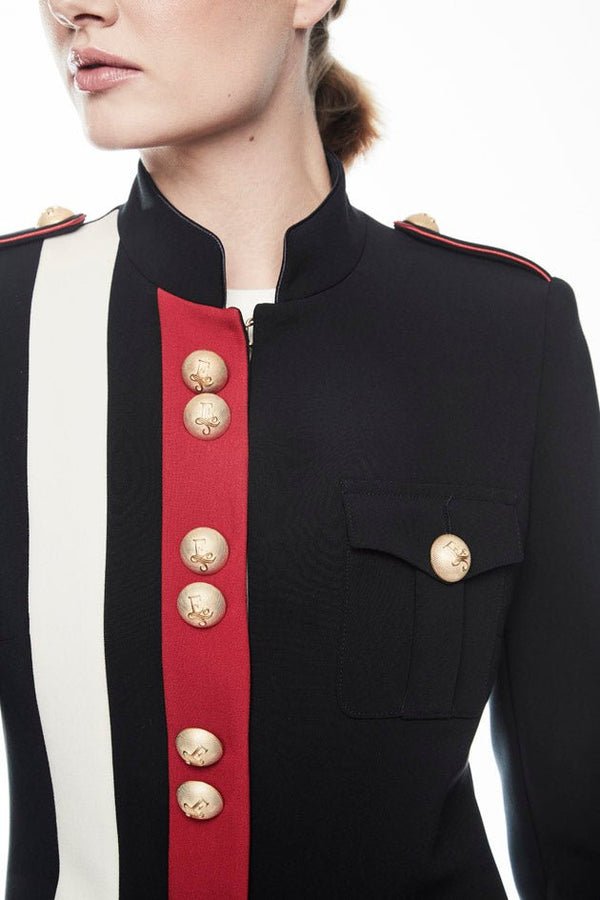
One of the more revealing aspects of the military jacket’s journey through fashion is what happened when embellishment entered the equation. The base silhouette, defined shoulder, structured front, precise collar, proved capable of absorbing decoration without losing its authority.
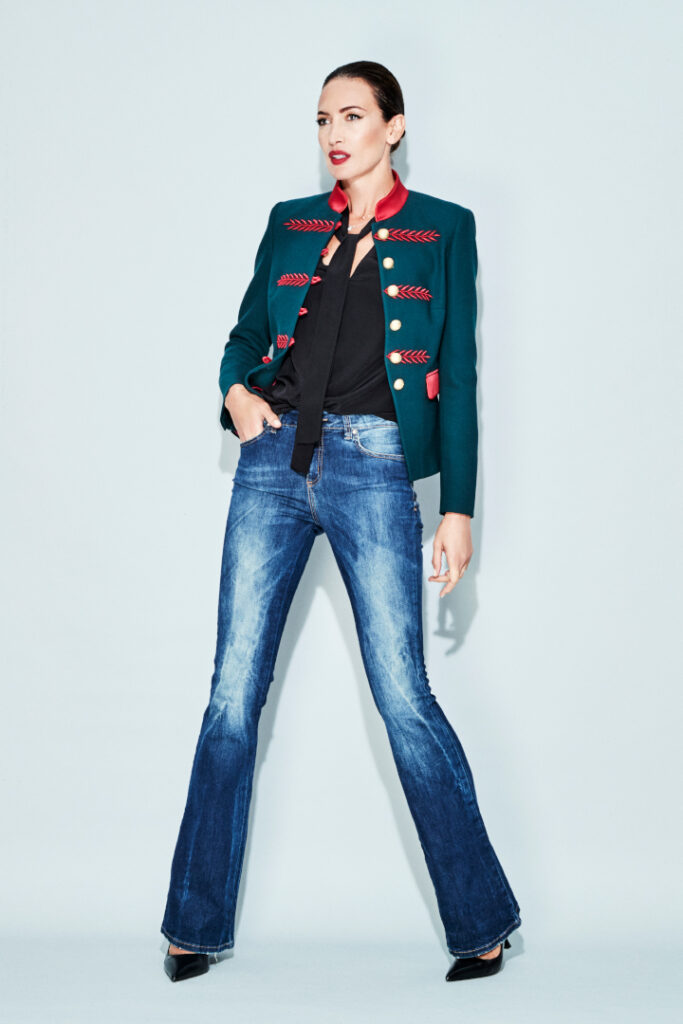
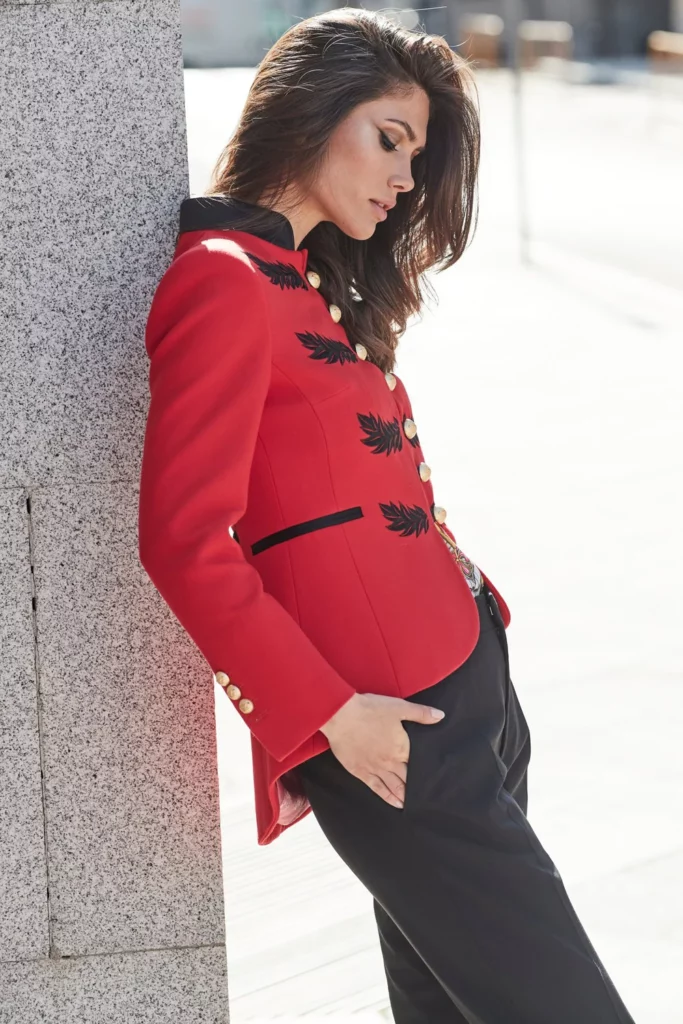
Embroidered detailing, contrast trims, and ornamental hardware have all appeared on military jackets across decades without fundamentally altering what the garment communicates. This is because the embellishment works with the structure rather than against it. A gold braid on a defined shoulder reads differently than gold braid on a soft cardigan. The architecture provides the context in which the decoration becomes meaningful rather than merely decorative.
The military jacket’s capacity to absorb embellishment while retaining its essential character is part of what makes it so durable as a design reference. It can be minimal or ornate, severe or celebratory, without ceasing to be itself.
Today: Authority Without Apology
The contemporary military jacket women choose operates with a different confidence than its predecessors. It does not need to be political, or subversive, or aspirational in the specific ways those earlier iterations required. It has earned the right to simply be a well-made garment with a strong silhouette.
What the best contemporary interpretations share with every earlier generation of the military jacket is the same underlying commitment: to use structure as a means of expanding, rather than diminishing, the presence of the person wearing it. The shoulder still defines the frame. The vertical closure still creates proportion. The precision of the detailing still communicates that the wearer made a deliberate choice.
That deliberateness is what connects a 1966 Mod jacket to a 1977 punk appropriation to a 1985 power-dressing staple to the luxury military blazer of today. The garment changes. The intention behind it does not.
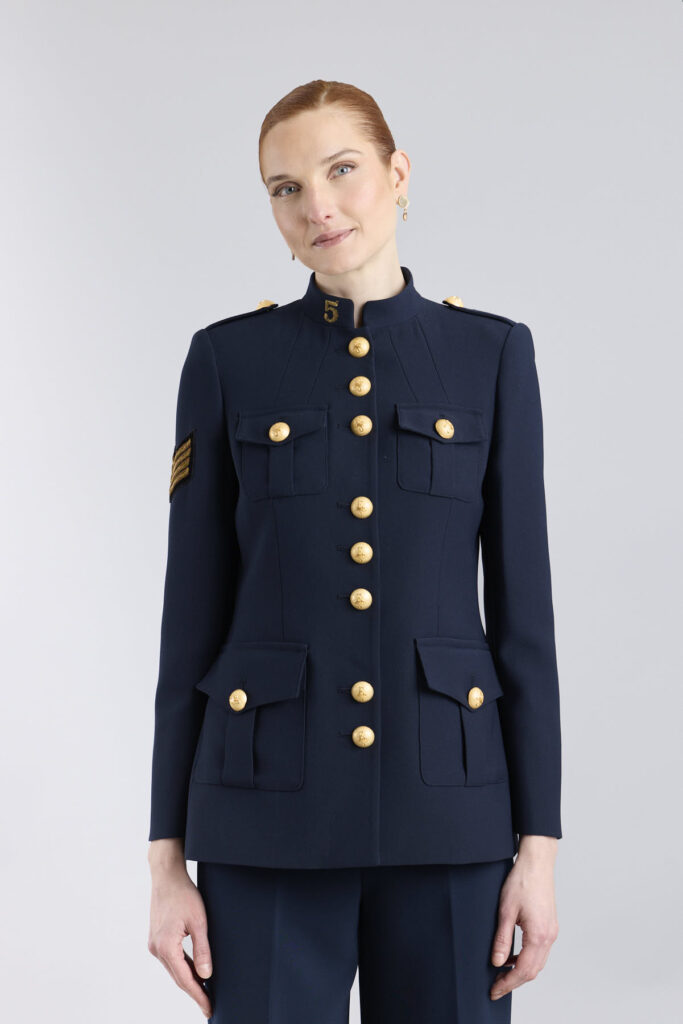
A staple. The military jacket has appeared in women’s fashion consistently since the 1960s, across movements as different as Mod, punk, and power dressing. Its structural properties, defined shoulder, vertical proportion, and precision detailing, are architectural rather than decorative, which means they do not expire with seasonal trends. Contemporary luxury interpretations continue to draw on the same underlying logic.
The Craft Behind the Silhouette
None of this cultural history matters without construction. A military jacket that cannot hold its shoulder line, that loses its structure after a season of wear, or that achieves the surface appearance of the silhouette without its underlying architecture is not participating in this tradition. It is referencing it without earning the reference.
The garments that have carried the military aesthetic through six decades of fashion were built to perform. Their structure was not applied to the surface but embedded in the cut, the interfacing, the seam allowances, the weight of the fabric. The result is a garment that holds its shape under real conditions, worn by real women living real lives.
This is the standard that luxury military tailoring must meet, and the standard against which contemporary interpretations deserve to be judged. How to approach that judgment in practice, including how contemporary military jackets for women translate across occasions and contexts, is explored in our editorial on how to style a military blazer for modern wardrobes.
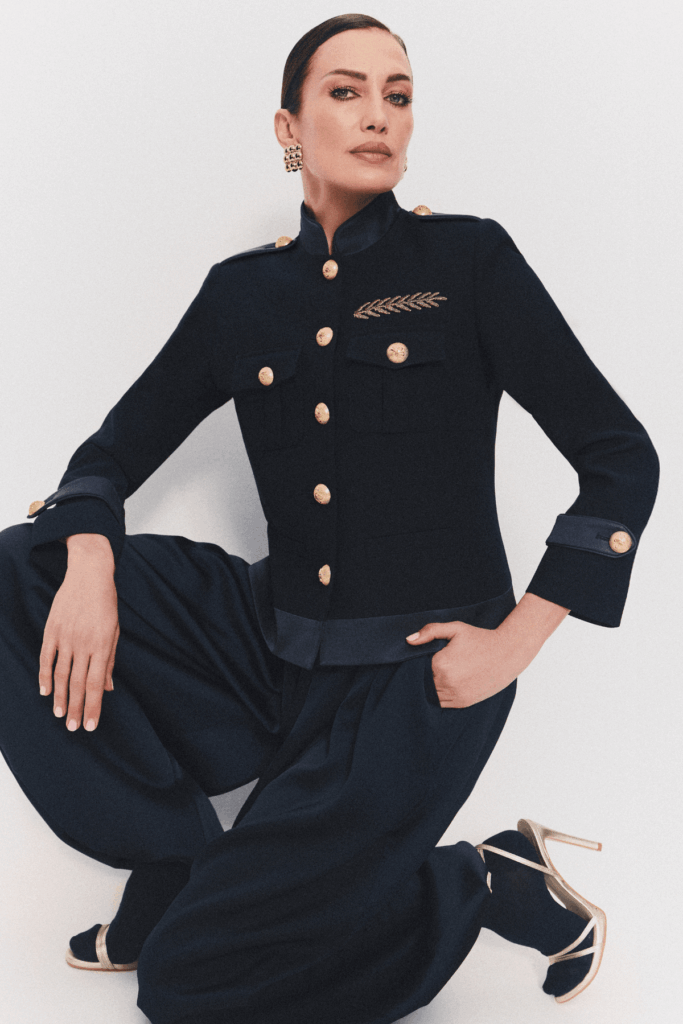
The full current collection of military jackets for women is available at The Extreme Collection USA, where each piece is made in Spain to the standard the silhouette has always demanded.