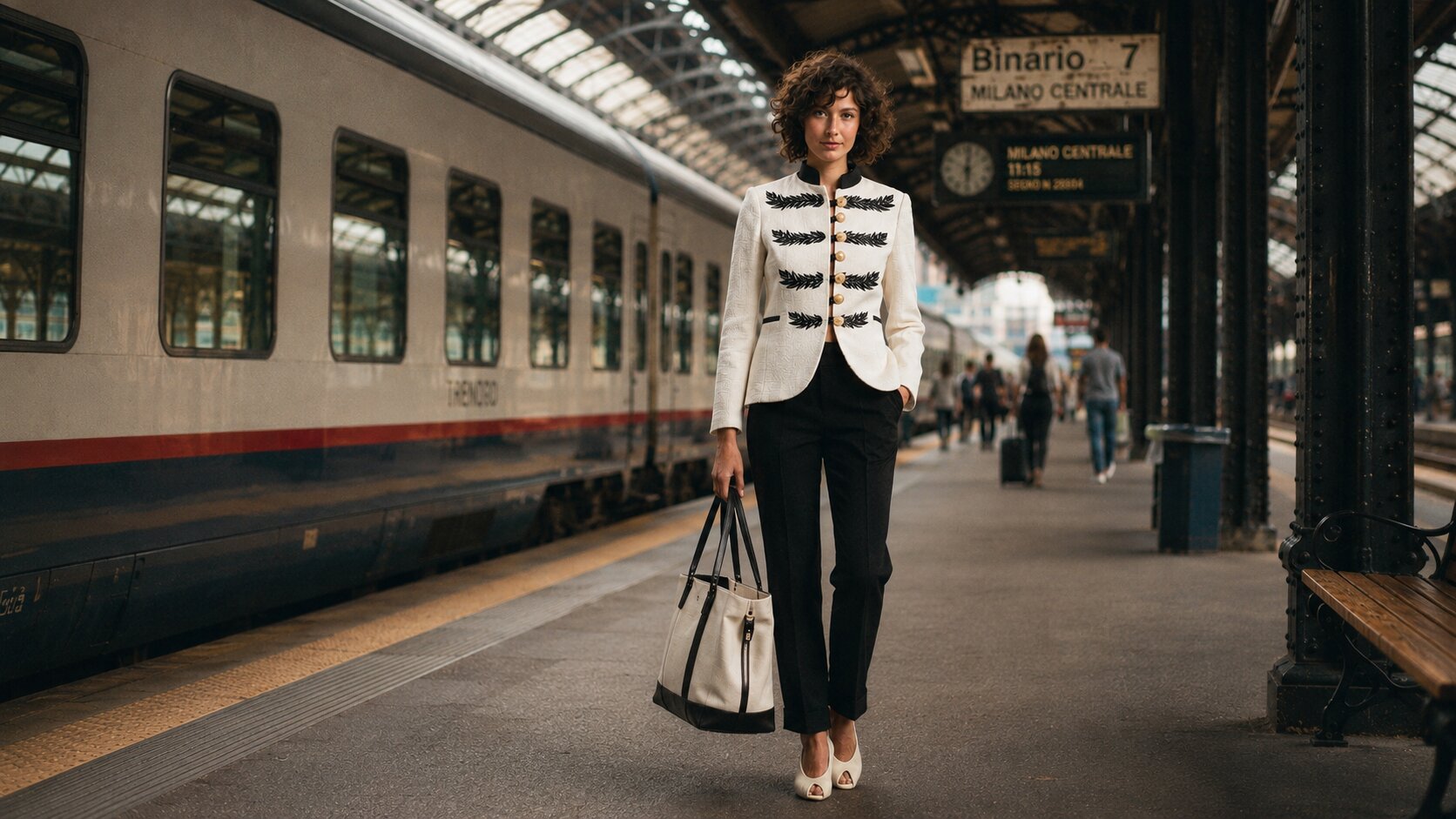
The problem with packing for travel is not what to bring. It is what to bring that does more than one job. A wardrobe assembled from single-purpose pieces produces luggage that is too heavy, a morning routine that takes too long, and an outfit for every occasion except the one that arrives unexpectedly. The blazer solves this problem more efficiently than any other garment. One piece, correctly chosen, covers the airport, the client meeting, the restaurant, and the rooftop event, without requiring a checked bag or a change of plan.
This is not a new idea. Experienced travelers have understood the value of a single versatile jacket for decades. What has changed is the quality of the pieces available and the understanding of which specific garment does the job best. The answer, consistently, is the blazer.
There is a less practical argument for the travel blazer, and it is the more important one. When you arrive somewhere new, nobody knows who you are. The hotel, the client, the restaurant, the room full of people you are about to meet for the first time: they will form their first impression of you in the seconds before you speak. The blazer does not create who you are. It ensures that who you are is the first thing they see.
Not a cardigan, not a soft jacket, not a wrap. A structured blazer in a fabric that holds its shape and performs across every register travel requires. Explore the full range of blazers for women at The Extreme Collection USA.
Why the Blazer Outperforms Every Other Travel Jacket
Travel dressing has a specific set of requirements that most garments fail to meet simultaneously. The jacket needs to look presentable after hours of sitting in a plane or a car. It needs to transition from the casual register of transit to the professional register of a meeting without requiring a change. It needs to work with the limited wardrobe a carry-on allows. And it needs to do all of this while remaining comfortable enough to wear for an extended period.
A soft jacket or a cardigan meets the comfort requirement but fails the professional one. A suit jacket meets the professional requirement but fails the versatility one: it belongs to the suit and reads as incomplete without it. A casual coat meets neither requirement in a way that justifies its bulk in the luggage.
The blazer meets all of them. Its structured construction holds its shape through hours of wear without requiring pressing or steaming when you arrive. Its versatility covers the full range of travel occasions from the airport lounge to the formal dinner. Finally, its size is manageable: worn on the plane or folded flat on top of the suitcase, it adds minimal weight and bulk to any travel configuration. No other single garment comes close to this performance across all three requirements simultaneously.
A structured blazer is the most versatile and practical jacket for travel. It holds its shape through hours of transit, transitions from casual to professional contexts without requiring a change of outfit, and works with the limited wardrobe a carry-on allows. A blazer made with canvas interlining and quality fabric arrives looking as considered as it did when packed, which no soft jacket or cardigan can replicate. For travel specifically, a military blazer’s structured construction makes it particularly resilient under the physical demands of a travel day.
Construction Is the Travel Performance Factor
The difference between a blazer that travels well and one that does not comes down entirely to construction. A fused blazer, built with adhesive bonding rather than canvas interlining, degrades under the physical demands of travel. It wrinkles more deeply, loses its shape more quickly, and requires more attention to recover after a long flight. A canvas-interlined blazer behaves differently. The structure derives from a stitched layer of woven fabric rather than adhesive, which means it moves with the wearer rather than against them, returns to its natural shape after being worn for hours, and recovers from packing more readily than a fused alternative.
Fabric choice matters equally. A crepe blazer holds its shape through extended wear because the fabric’s tight weave resists the surface distortion that looser constructions develop under pressure. A structured wool blend performs similarly in cooler conditions. Linen, while beautiful in appropriate contexts, wrinkles under travel conditions in a way that crepe does not. For a piece that needs to arrive looking as considered as it did when packed, fabric selection is not a minor detail.
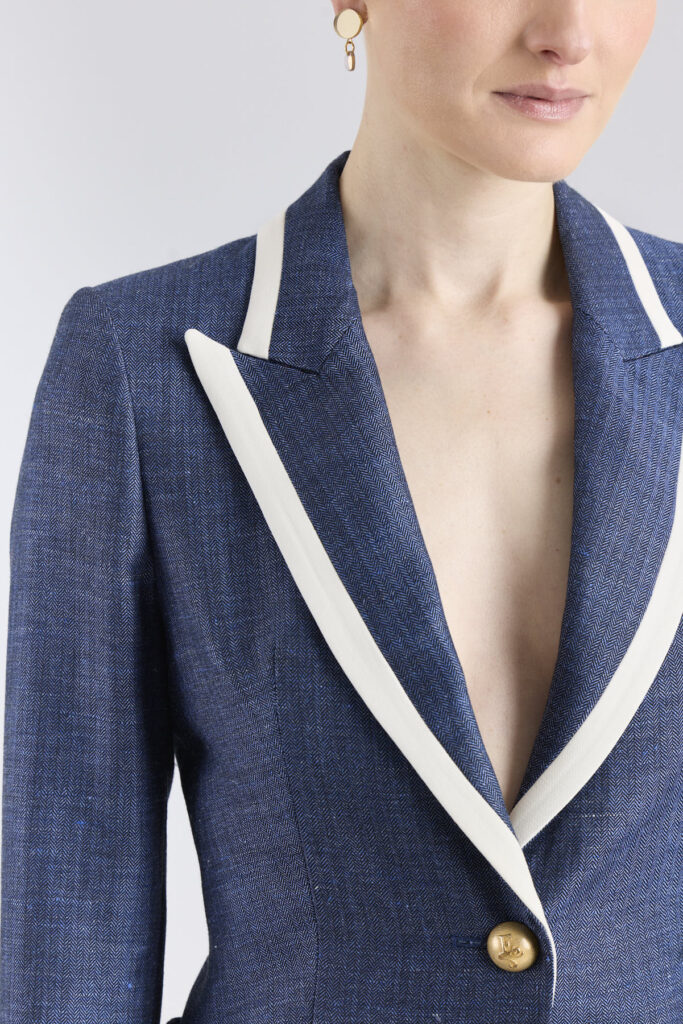
The blazer below makes this construction argument tangible: a refined tailored silhouette in a fabric and construction that holds its line through a full travel day and arrives at the destination without the wrinkles or shape loss that lesser pieces accumulate in transit.
One Blazer, Every Occasion
The travel blazer’s primary value is its capacity to cover multiple occasions without requiring additional pieces to complete each outfit. A woman traveling for three days with one blazer can dress differently for each context by changing what sits beneath and below it, while the blazer itself remains constant. This is the wardrobe efficiency that travel demands and that the blazer delivers more effectively than any other garment category.
On the travel day itself, the blazer over dark trousers or jeans with a simple top covers the airport, the lounge, and the first meeting at the destination without requiring any adjustment. The blazer signals that the wearer is traveling with purpose rather than simply moving between locations. It communicates consideration in a context that typically favors comfort at the expense of everything else.
For the professional day that follows, the same blazer over a fitted blouse and tailored trousers handles the client meeting, the lunch, and the afternoon without requiring a second jacket. The quality of the piece, its construction, its fabric, the precision of its shoulder, does the professional communicating that the context requires.
For the evening occasion that closes the professional day, the blazer’s ability to transition registers means that only the garment beneath it needs to change. The blazer stays. The blouse becomes something more refined. The combination is complete without adding a second jacket to the luggage.
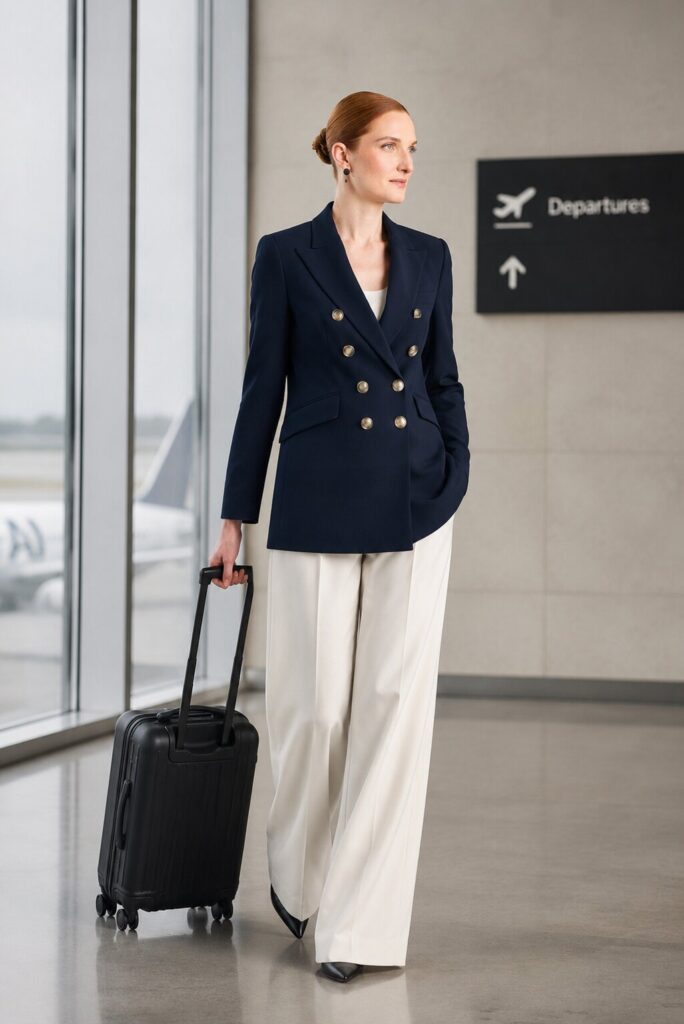
The blazer below performs across all three of these contexts: a double-breasted navy construction with enough formal weight to carry a client dinner while remaining entirely viable for the travel day that precedes it. The kind of piece that earns its place in a travel wardrobe by covering more ground than any two single-purpose alternatives could manage.
The most reliable method for packing a blazer without wrinkles is to fold it inside out with the shoulders nested together, then fold it in half lengthwise and place it flat on top of everything else in the suitcase. A canvas-interlined blazer recovers from this treatment more readily than a fused one. For carry-on travel, wearing the blazer on the plane and removing it during the flight keeps it in better condition than packing it. A well-made blazer in a crease-resistant fabric such as crepe or structured wool blend requires minimal attention after unpacking.
The Military Blazer as the Ultimate Travel Piece
The military blazer earns a specific mention in the context of travel dressing because its construction qualities align particularly well with what travel demands. The defined shoulder holds its line through hours of sitting, standing, and moving in a way that a softer blazer cannot maintain. The structured front remains clean and precise without requiring steaming or pressing after a long flight. The military silhouette’s inherent authority means it communicates professionalism the moment it is put on, regardless of how many time zones have been crossed since it was last unpacked.
The military blazer also performs the occasion-transition function more effectively than a standard blazer because its visual weight is greater. A standard blazer can read as slightly underdressed in a high-end restaurant or a formal client setting when worn with travel-day basics beneath it. A military blazer does not have this problem. Its structure and presence are sufficient to elevate whatever surrounds it, which means the transition from travel day to professional occasion requires less adjustment of the supporting garments.
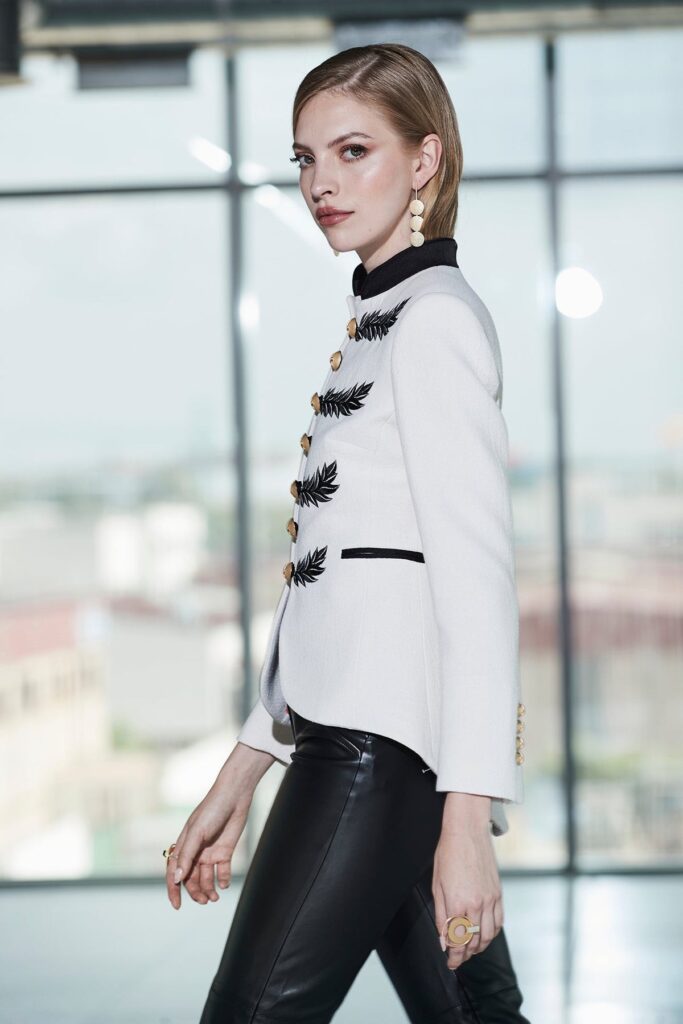
The blazer below is the travel military silhouette at its most versatile: a raw, textured construction with enough body and presence to anchor a travel wardrobe across every context the journey requires, from the departure lounge to the destination dinner.
Building a Travel Wardrobe Around the Blazer
The most efficient travel wardrobe places the blazer at the center and builds outward from it. Every other piece in the luggage should work with the blazer rather than requiring a second jacket to complete a different occasion. This is the principle that reduces a travel wardrobe from a large checked bag to a carry-on without sacrificing the capacity to dress appropriately for any context that arises.
Two or three simple tops in complementary neutrals cover the range of what sits beneath the blazer across different occasions. Dark trousers or well-fitted dark jeans provide the bottom half for professional and smart casual contexts. A simple dress for evening occasions doubles as the base beneath the blazer for a more formal dinner. The blazer unifies all of these pieces into a coherent wardrobe without requiring each one to carry its own occasion-specific jacket.
The investment logic is particularly clear in a travel context. A well-made blazer that performs reliably across three days of travel is worth significantly more than three separate jackets that each handle one context adequately. The cost per wear of a high-quality piece decreases with every journey it accompanies. The cost of carrying additional luggage, checking bags, and managing multiple jackets across different contexts increases with every trip.
The blazer below illustrates the versatility that makes this investment logic work: a linen construction in a warm hazelnut tone that reads as professional in cooler interiors and as refined casual in the outdoor social contexts that travel frequently produces.
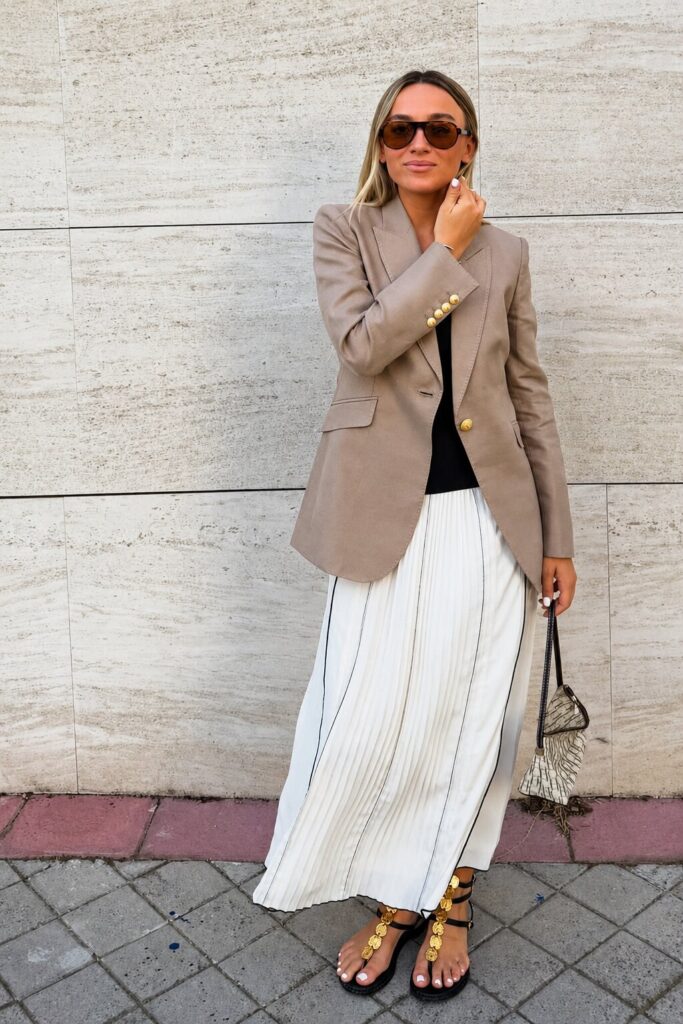
A structured blazer is the single most valuable piece a woman can include in a travel wardrobe. It covers the airport, the professional meeting, the restaurant, and the evening occasion without requiring additional jackets for each context. Build the travel wardrobe around the blazer: two or three simple tops in complementary neutrals, dark well-fitted trousers or jeans, and a simple dress for evening occasions. The blazer unifies all of these pieces across every context travel requires.
Travel strips away the familiar context that usually supports how you are perceived. Your office, your reputation, your network: none of these travel with you in the same way. What does travel with you is how you carry yourself and what you wear when you do it. The blazer is the piece that ensures the impression you make in a new city, a new room, or a new meeting is exactly the impression you intend. Not because clothing determines worth. Because presentation shapes perception. And a well-made blazer, worn with intention, changes the way the world receives you — wherever you arrive.
For guidance on how the military blazer specifically performs across the full range of professional and social occasions that travel produces, our post on how to wear a military blazer from the office to the weekend covers the transitions in detail. For the broader investment logic behind building a wardrobe around fewer, better pieces, our post on what makes European tailoring different explains the construction standard that makes the difference between a blazer that travels well and one that does not.
The full collection of blazers for women and military blazers is available at The Extreme Collection USA, each piece made in Spain and built to perform across every context travel requires.