
You already know who you are. The question August asks, Women’s Equality Month, the month that marks more than a century of women insisting on the right to be taken seriously, is whether the world receives you that way. Whether the room you walk into sees what you already know about yourself. Whether the first impression you make reflects the woman you actually are rather than the woman the occasion expected you to be.
Clothing has always been part of that conversation. Not because what a woman wears determines her worth. It does not. But because presentation shapes perception, and perception shapes opportunity. The woman who walks into a room and is immediately received as authoritative, capable, and worth listening to has an advantage over the woman who has to establish those qualities through her words and actions alone. Dressing with intention is one of the oldest tools available for closing that gap. It has never been more relevant.
There is a difference between getting dressed and meaning it. Most people do the former. Fewer do the latter. Getting dressed is reactive: you open the wardrobe, you find something that works well enough, and you leave. Meaning it is something else entirely. It is the decision to choose what you wear with the same deliberateness you bring to every other significant choice in your day. Not more effort. More intention.
The woman who dresses like she means it does not necessarily spend more or own more. She simply knows what each piece communicates and chooses accordingly. She understands that clothing is not decoration. It is language. And like every other form of language, it rewards the people who use it with precision. Explore the full range of blazers for women at The Extreme Collection USA.
What It Means to Dress with Intention
Dressing with intention begins with a question most people never ask: what do I want this outfit to communicate? Not what is appropriate, not what matches, not what is comfortable, though all of these matter. What does this combination of choices say about who I am and how I intend to be received?
The answer changes depending on the day, the occasion, and the room. But the act of asking it is what separates intentional dressing from its alternative. A woman who asks the question and answers it honestly is making a choice. A woman who does not ask it is leaving the answer to chance.
Intentional dressing is not about following rules. It is about understanding them well enough to break them when the moment calls for it. The woman who knows exactly why she is wearing a black and white plaid blazer to a meeting that expects navy has thought about what she wants to communicate. She has decided that the signal she is sending is worth sending. That is dressing like you mean it.
The blazer below is the piece that rewards this kind of thinking. A wool blend tartan in black and white with a velvet collar, gold plated buttons, and a swallowtail hem that reads as entirely distinctive in any room that expects the predictable. Wearing it is a statement. Not because it is loud. Because it is deliberate.
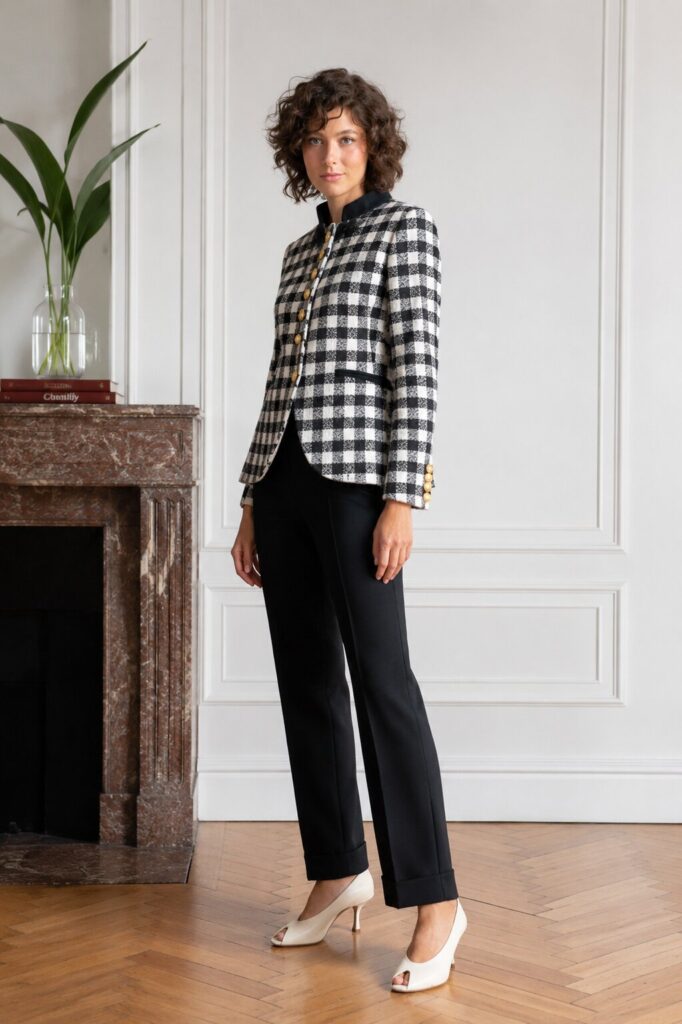
Dressing with intention means choosing what you wear with the same deliberateness you bring to every other significant decision in your day. It begins with a question: what do I want this outfit to communicate? The answer shapes the choices. A woman who dresses with intention understands that clothing is a form of language, and that using it precisely produces more consistent results than leaving it to chance or habit.
The Opposite of Dressing to Comply
Most dressing is compliance. It meets the requirements of the occasion, the workplace, the social context, without saying anything more specific than “I understood the dress code.” Compliance dressing is not wrong. It is simply insufficient for the woman who wants her clothing to do more than clear the minimum bar.
Dressing like you mean it is the opposite of compliance. It does not ignore the context. It understands it well enough to respond to it on its own terms. A business casual event does not require a standard blazer in a standard neutral. It requires a blazer that communicates something specific about the woman wearing it, while remaining within the register the occasion calls for. The distinction between the two approaches is visible from across the room.
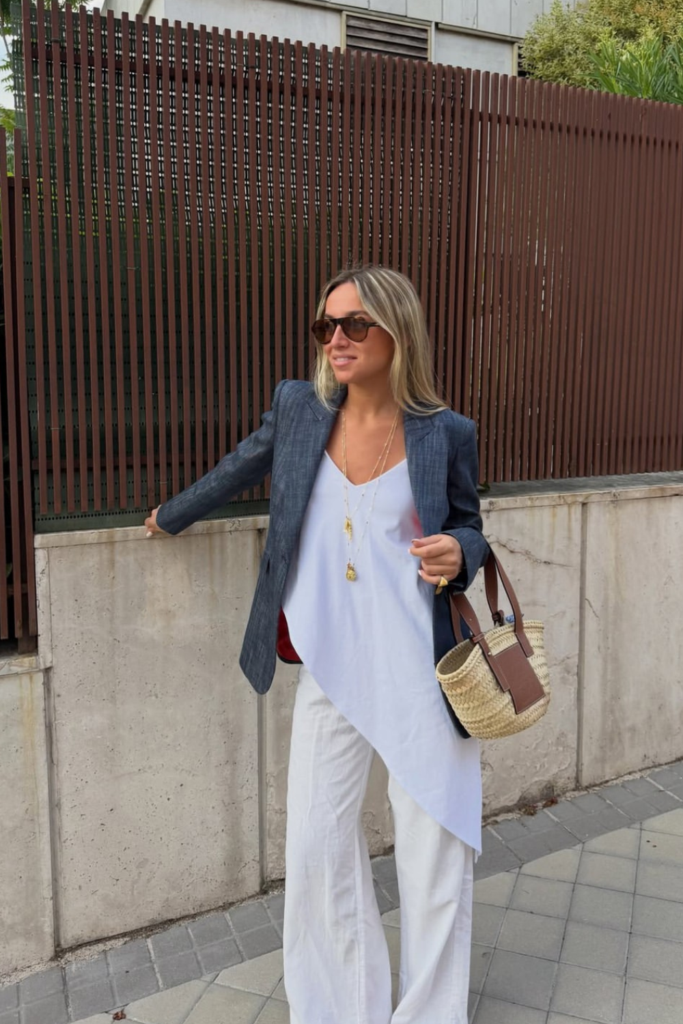
The woman who wears the same dark denim blazer to a creative industry dinner that everyone else wears to their commute has complied with the dress code. The woman who shows up in a dark denim blazer with gold buttons, tailored with the precision of a structured garment rather than the casualness the fabric implies, has made a statement about what she brings to the room. Same category. Different intention. Completely different result.
The blazer below makes exactly this distinction visible: dark denim elevated through tailored construction, gold button detailing, and a silhouette that does not behave the way denim is expected to behave. It is the unexpected choice made deliberately.
On Wearing Something That Takes a Position
Some pieces are neutral. They work everywhere, with everything, without declaring anything. There is real value in those pieces and a well-built wardrobe needs them. But a wardrobe built entirely of neutral pieces belongs to a woman who has decided that clothing should not take positions on her behalf. That is a choice. It is not the only one available.
A piece that takes a position communicates something specific: a point of view, a set of values, a refusal to be indistinguishable from everyone else in the room. A studded blazer takes a position. It says that the woman wearing it understands the vocabulary of edge and authority and has chosen to bring both into a context that might not have expected them. That is not aggression. It is confidence operating at a frequency that most wardrobes do not reach.
The blazer below takes this position directly: stud detailing that traces the lapel and front with a sophisticated texture that reads as both rebellious and refined. It is not a piece for the woman who wants to be comfortable in the room. It is a piece for the woman who wants the room to notice that she has arrived.
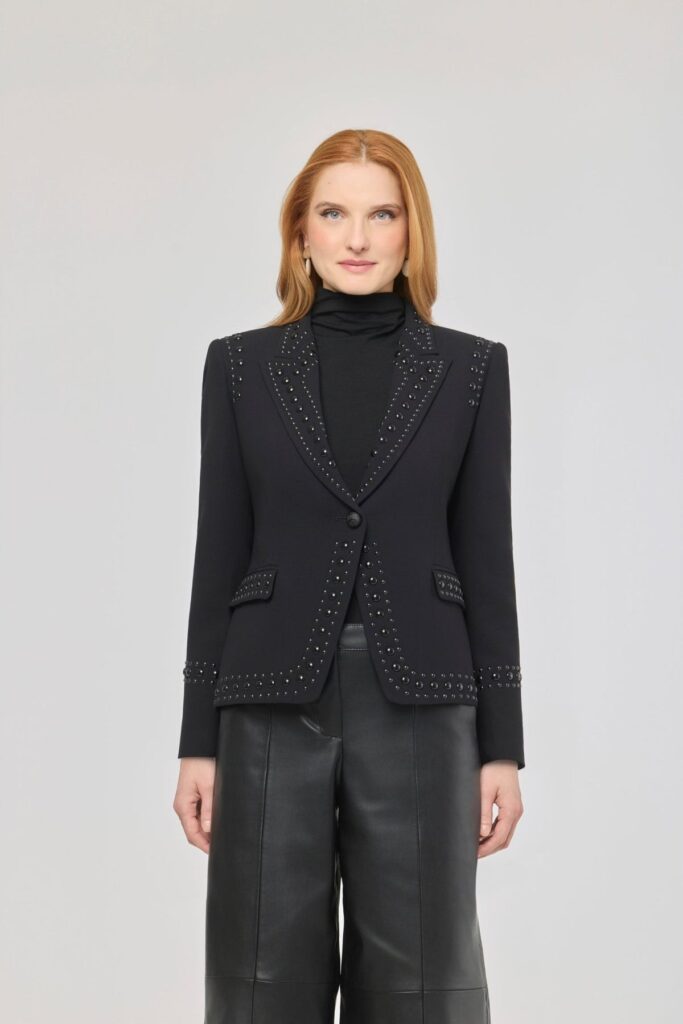
Personal style develops when you stop dressing for the occasion and start dressing for yourself within the occasion. It requires understanding what specific garments communicate and making choices that reflect something true about who you are rather than simply what is expected. A distinctive piece chosen deliberately communicates more about the wearer than a wardrobe full of safe choices. Start with one piece that you chose because it says something specific, and build outward from there.
Authority as a Choice
Some women dress for authority. Others dress despite it, as though appearing too considered or too deliberate might read as trying too hard. The second approach misunderstands what authority in dressing actually is. It is not effort made visible. It is intention made invisible. The woman who looks authoritative in her clothing looks that way because the clothing is doing its job without requiring the observer to think about it.
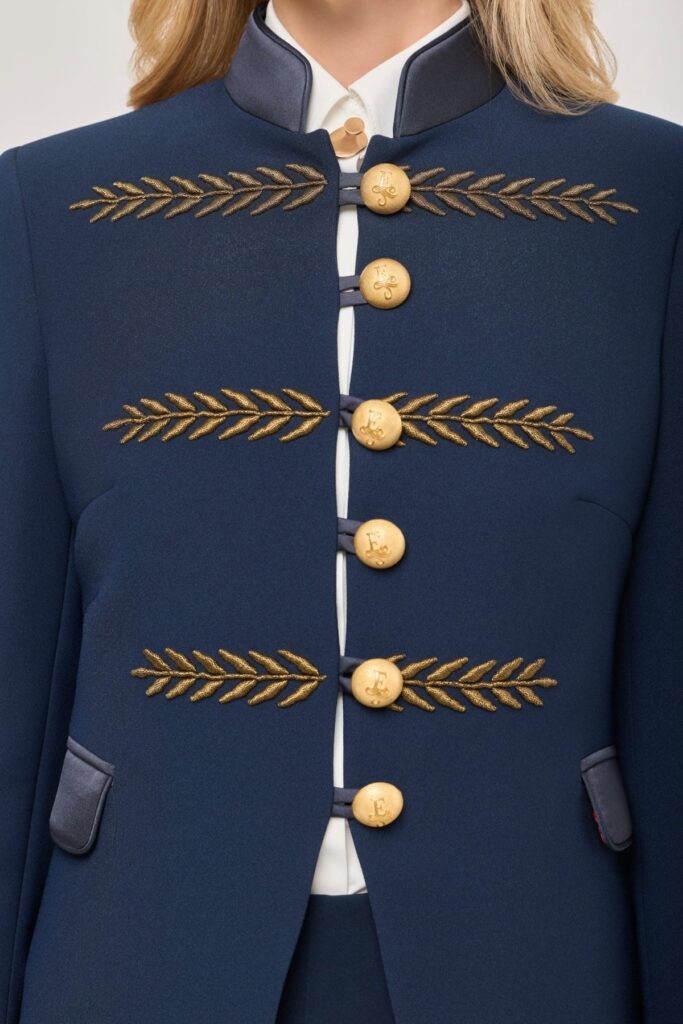
A military blazer communicates authority through its architecture rather than its decoration. The defined shoulder, the precision of the front closure, the cropped silhouette that draws the eye upward: these are structural decisions with communicative consequences. They do not announce themselves. They simply produce a result that the room receives before anyone has consciously processed why.
The blazer below takes this authority and adds the dimension of artisanal distinction: a cropped navy silhouette with gold thread embroidery running down the front, designed by artisans who understand that embellishment placed with precision communicates something that embellishment placed for decoration does not. This is a piece that knows exactly what it is doing.
Dressing Like You Mean It in Every Register
Dressing with intention is not reserved for formal occasions or high-stakes moments. It applies equally to the Saturday afternoon and the creative work environment and the casual dinner with people who matter. The register changes. The intention does not.
In a relaxed context, dressing like you mean it means choosing pieces that communicate ease and personality rather than defaulting to whatever requires the least thought. A distinctive knit jacket over simple dark trousers says that the woman wearing it made a choice about how she wanted to show up to this particular afternoon. That choice reads. It does not need to be formal to be intentional.
The jacket below makes this case for the relaxed register: a hazelnut two-tone knit construction with collarless cut and jewel-inspired heraldic buttons that catch the light against the textured fabric. It is not trying to be a blazer. It is not trying to be a sweater. It is exactly what it is, chosen with complete conviction, which is the definition of dressing like you mean it in any context.
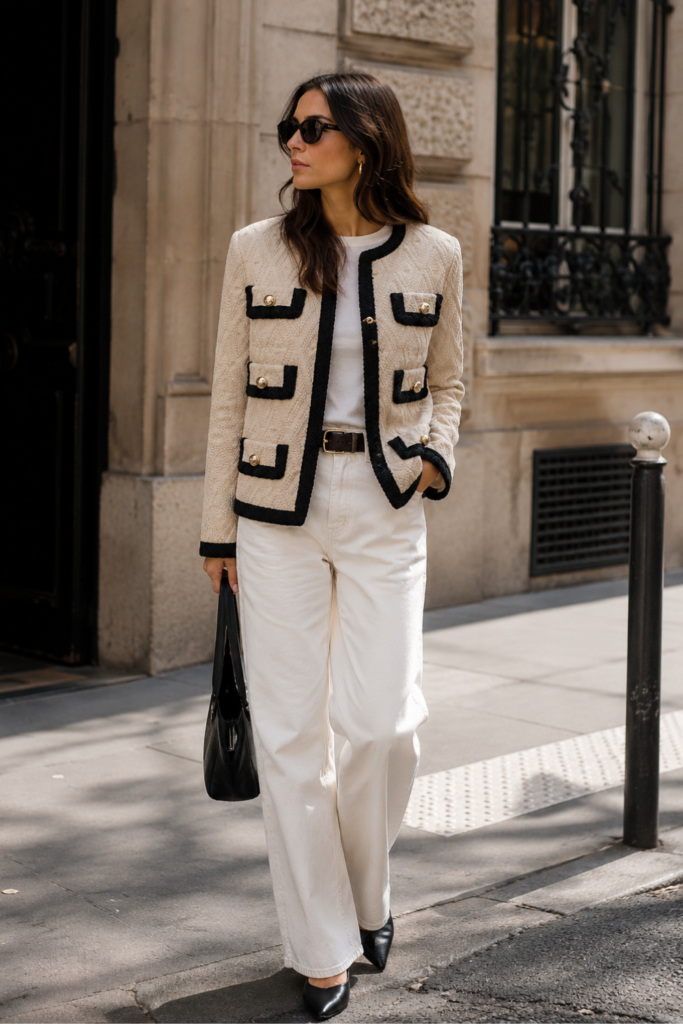
Dressing with confidence is less about the specific pieces you own and more about the relationship you have with each choice you make. A woman who knows why she is wearing what she is wearing and has chosen it deliberately reads as confident regardless of the specific garment. The clothing does not create the confidence. It amplifies what is already there. Start by choosing one piece that communicates something specific about who you are, and build the outfit around it rather than around what is expected.
Dressing on Your Own Terms
Women’s Equality Month is not about a single moment in history. It is about an ongoing insistence: the refusal to be defined by how others have decided to receive you and the determination to shape that reception on your own terms. Dressing with intention is one expression of that insistence. It is the daily act of deciding how you will be seen before anyone else has had the chance to decide for you.
This is not a small thing. Every woman who has ever walked into a room and felt the shift in how she was received when she was dressed with precision rather than compliance understands what that shift produces. The meeting that begins differently. The introduction that lands differently. The negotiation that starts from a different position. These are not coincidences. They are the consequences of intentional dressing applied consistently over time.
The right to be taken seriously is not something that clothing can grant. But the act of dressing as though you expect to be taken seriously changes the terms on which every room receives you. That is what dressing on your own terms means. Not performance. Presence. Less effort to be seen. More clarity about who is doing the seeing.
The Wardrobe That Means It
A wardrobe built around intention looks different from a wardrobe built around accumulation. It is not necessarily smaller, though it often is. It is more coherent. Every piece in it was chosen because it communicates something specific, because it performs reliably across the contexts it enters, and because the woman who owns it knows exactly when and why to reach for it.
The blazer is the piece most likely to anchor this kind of wardrobe because it is the piece that communicates intention most reliably across the widest range of contexts. A well-made blazer in the right hands does not just cover occasions. It defines them. It walks into a room and changes the terms on which the room operates. That is not an exaggeration. It is what dressing like you mean it actually produces.
Style is not about fashion. It is not about spending more or owning more or keeping pace with whatever the season has decided is relevant. It is about knowing who you are and choosing clothing that ensures the world receives you that way. August is the month that reminds us why that matters. The clothing does not create that knowledge. It amplifies it. And the woman who has that knowledge, expressed through a wardrobe chosen with complete conviction, changes the way the world responds to her every time she walks into a room.
For guidance on building a wardrobe around fewer, more intentional pieces, our post on how to build a minimalist wardrobe around a blazer covers the decisions in full. For the construction standards that make the difference between a blazer that communicates and one that simply covers, our editorial on what makes European tailoring different explains what to look for. The full collection of blazers for women and military blazers is available at The Extreme Collection USA, each piece made in Spain and built for the woman who dresses like she means it.