
Houndstooth is one of the few patterns that has never truly disappeared. It evolves, adapts, and reappears in new forms of tailoring, always maintaining its visual authority.
In modern wardrobes, houndstooth jackets for women have moved well beyond tradition. Today, designers reinterpret them through structure, silhouette, and texture, making them a key element within contemporary blazer design.
This is where heritage meets modern tailoring.
The Enduring Power of the Houndstooth Pattern
Contrast and rhythm define houndstooth. Its geometric repetition creates movement even in stillness, making it one of the most visually structured patterns in fashion.
Unlike flat fabrics, houndstooth introduces depth without relying on color alone. It works seamlessly across structured blazers, tailored jackets, and transitional knitwear pieces precisely because the pattern itself carries visual weight. Color becomes secondary. Structure leads.

In modern tailoring, the pattern no longer serves a purely decorative role. It becomes architectural, a structural element in its own right. That shift is visible throughout the women’s blazers collection, where structure and pattern work together to define each piece.
Beyond structured tailoring, houndstooth also appears within knitwear, where texture replaces rigid structure while maintaining the same visual identity.
Houndstooth is a classic pattern that consistently reappears in modern tailoring. Its structured design allows it to evolve without losing its identity.
From Heritage to Modern Tailoring
Originally associated with classic European tailoring, houndstooth has moved well beyond its traditional roots.
Today, it appears in sharper silhouettes, defined shoulders, and controlled proportions. Cropped jackets with clean lines, longline blazers with structured lapels, hybrid knit-tailored pieces: each represents a different answer to the same question of how a historic pattern earns its place in a contemporary wardrobe.
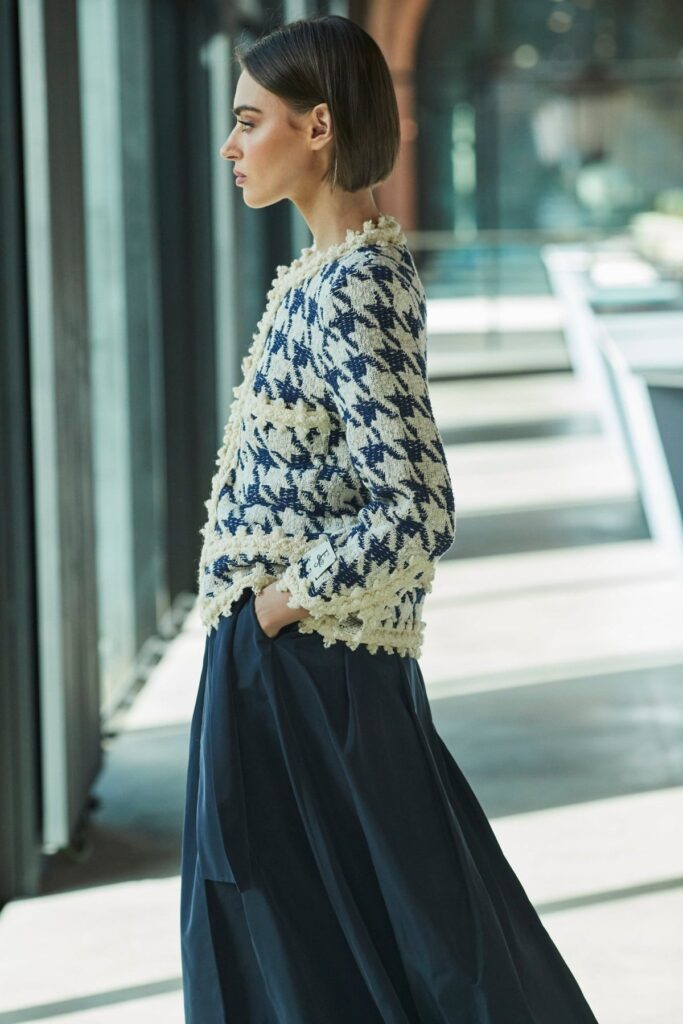
Houndstooth now sits comfortably alongside more contemporary blazer styles, including military-inspired tailoring. This is especially evident in pieces that balance structure and detailing, such as those found within our women’s tailored blazers collection, where modern cuts reinterpret traditional patterns.
The same precision that defines military blazers for women applies here: strong silhouettes and disciplined construction redefine how classic elements work in contemporary wardrobes. For a broader look at that structural language, the military blazers collection shows how far that discipline extends.
Modern houndstooth jackets focus on sharper silhouettes, refined proportions, and updated materials, moving away from looser, more traditional cuts.
Structure, Texture, and Visual Authority
What separates a modern houndstooth jacket from a traditional one is not the pattern itself, but how the maker constructs it.
Today’s designs rely on precision tailoring and material selection to control how the pattern reads. Defined shoulders create a strong silhouette. Precision tailoring controls volume. Fabric weight enhances the pattern’s depth. Structure defines presence, while texture refines it.
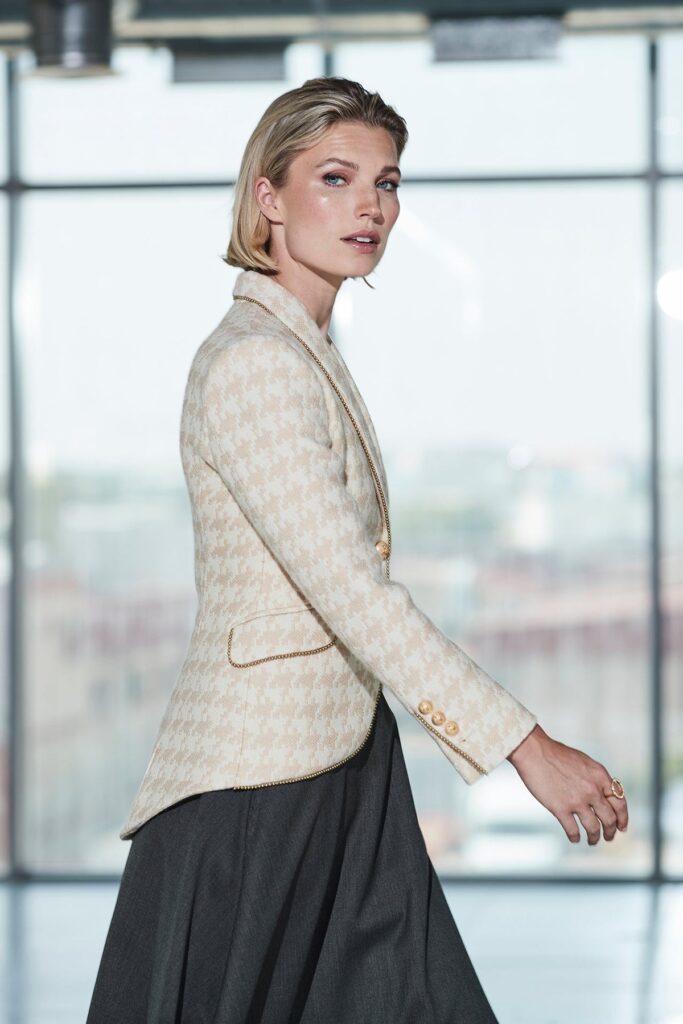
Consider the Honor Sand Houndstooth Blazer: a clean silhouette lets the pattern carry its own weight without overwhelming the structure. The restraint is intentional. Nothing competes with the geometry of the fabric itself.
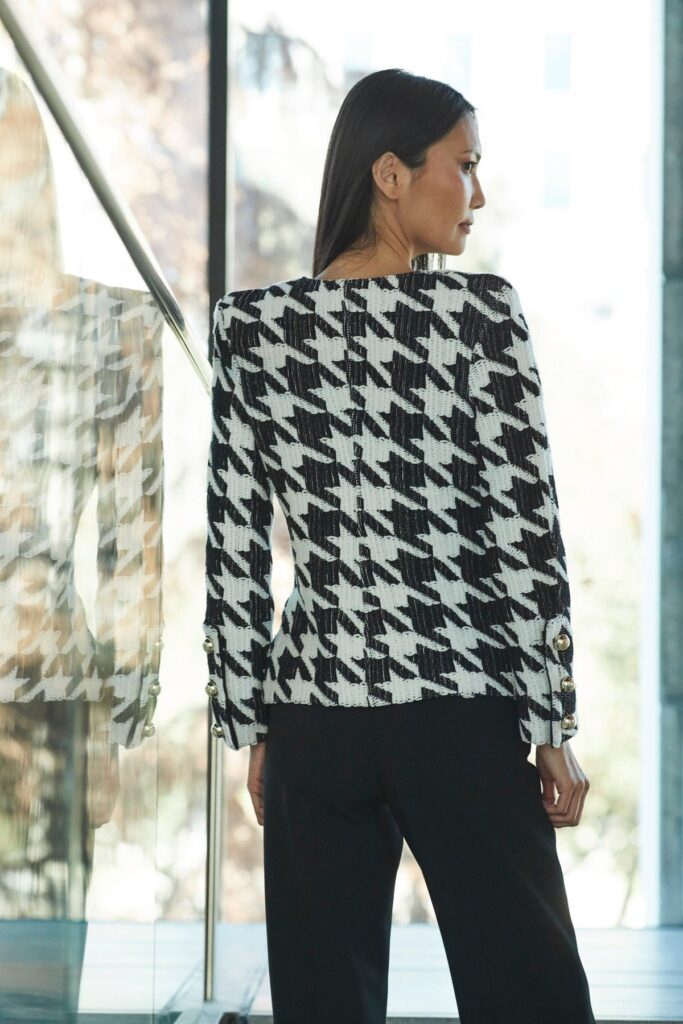
The Black Breton Houndstooth Jacket takes a different position: sharper visual rhythm, a stronger statement within a tailored form. The contrast between black and white reads with more intensity, and the construction frames that intensity without letting it become noise.
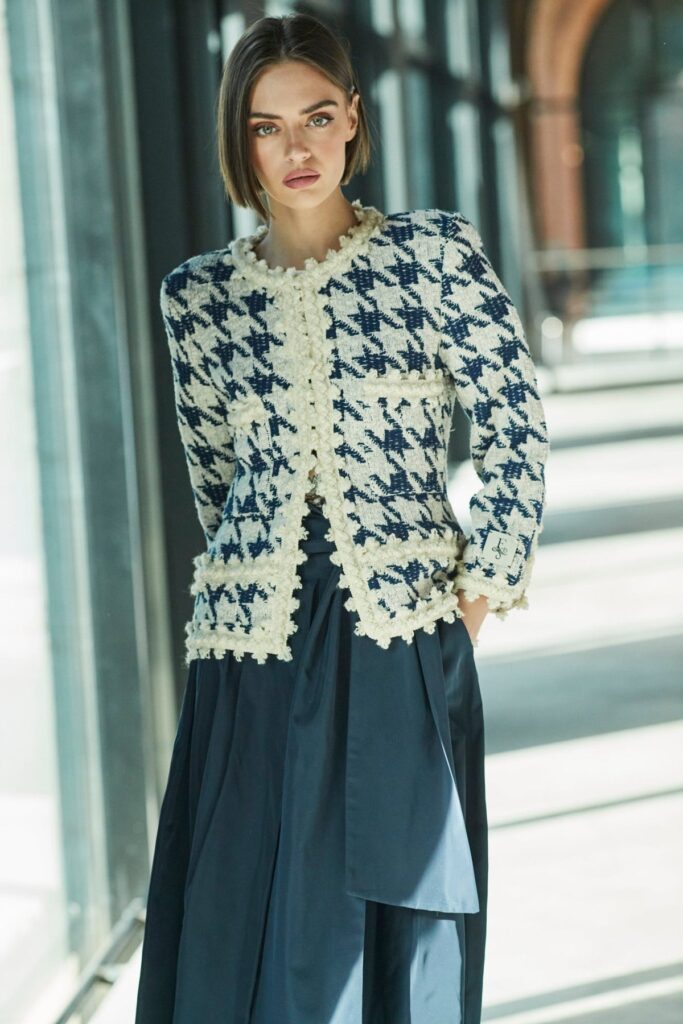
The Pascal Houndstooth Jacket shows how modern construction brings both elements together, combining texture and structure in a way that feels refined without excess. It is the piece that sits between the two: neither as restrained as the Honor nor as direct as the Breton, but entirely its own.
Yes. Houndstooth adapts to both tailored blazers and softer constructions, depending on fabric choice and garment structure.
Houndstooth Within the Modern Blazer Wardrobe
Within a broader blazer ecosystem, pattern, structure, and color work together to define a complete wardrobe. Houndstooth sits at the center of that connection.
Within a curated selection, houndstooth complements both minimal and expressive pieces. It adds texture without relying on bold color, making it a natural bridge between different styles of tailoring: solid structured blazers that provide balance, statement pieces that introduce color and contrast, and designs influenced by military tailoring where discipline is the primary language.

Our guide to choosing the perfect blazer explores this balance in depth, showing how different styles come together to form a cohesive wardrobe. For those drawn to stronger visual presence, our editorial on statement blazers shows where color and design play a more defining role.
Houndstooth sits between these two directions. It carries enough visual structure to stand out, while remaining versatile enough to integrate seamlessly with other tailored pieces. That is what makes it a foundational element rather than a seasonal trend: it anchors the wardrobe without limiting it.
It acts as a transitional piece that adds texture and structure while remaining versatile enough to complement both minimal and statement blazers.
Pattern as a Statement Without Excess
In modern tailoring, not every statement needs to rely on bold color or overt design. Houndstooth creates impact through pattern, contrast, and proportion. Contrast replaces saturation. Geometry replaces embellishment. Texture replaces excessive layering.
Rather than dominating a look, the pattern introduces structure in a controlled way. The repetition creates visual interest without overwhelming the silhouette. The garment remains the focus. The pattern reinforces it.
This is the same principle that runs through our approach to structured tailoring more broadly: presence earned through construction, not through excess. Each piece earns its place through detail and discipline, not through trend-driven decisions.
Modern Interpretations Across Textures
Not all houndstooth relies on rigid tailoring. In modern collections, the pattern evolves through different materials, adapting across silhouettes and levels of structure.
While traditional versions use woven fabrics, contemporary designers explore new textures that soften or redefine the pattern’s visual impact. Tweed-based houndstooth maintains classic structure. Knit interpretations offer softer silhouettes. Mixed fabric constructions add depth and variation that neither approach achieves alone.
This flexibility is part of what makes houndstooth so durable as a design reference. It moves seamlessly between categories without losing coherence. Structured pieces maintain strong architectural presence. Softer constructions offer a more relaxed expression of the same pattern, without diluting what makes it distinctive.
The Pascal Houndstooth Jacket reflects this balance well, combining texture and structure in a way that feels both modern and refined.
For a broader exploration of softer textures, houndstooth also extends into knitwear, where fabric rather than form carries the balance between comfort and structure. The pattern translates without effort. The identity remains.
For those exploring how to style a structured pattern piece within a modern wardrobe, our post on how to style a military blazer covers the same underlying logic: restraint in the surrounding garments, structure as the anchor, and construction as the point of interest.
No. While traditionally associated with structured tailoring, modern houndstooth also appears in softer fabrics like knitwear, offering a more relaxed interpretation.
A Foundation Piece in Contemporary Collections
Houndstooth jackets are not seasonal highlights. They are foundational pieces that provide continuity within a modern wardrobe.
Unlike trend-driven designs, the pattern holds consistent across collections, adapting through silhouette, texture, and construction rather than fading with changing seasons. It can anchor a look, introduce contrast, or complement more minimal tailoring without competing for attention. Few patterns manage all three with the same ease.
Within the broader blazers collection, it strikes a balance between classic and contemporary design, proving that structure and pattern can coexist without excess. And as collections evolve, houndstooth remains a constant reference point: connecting heritage with modern tailoring, making it a long-term investment rather than a seasonal choice.
The same could be said of the studded blazer: a different surface, the same underlying conviction that embellishment and structure should earn their place rather than simply occupy it.

Houndstooth remains one of the few patterns that earns its place in every season. Discover the latest interpretations within our women’s blazers collection and find the piece that defines your wardrobe.